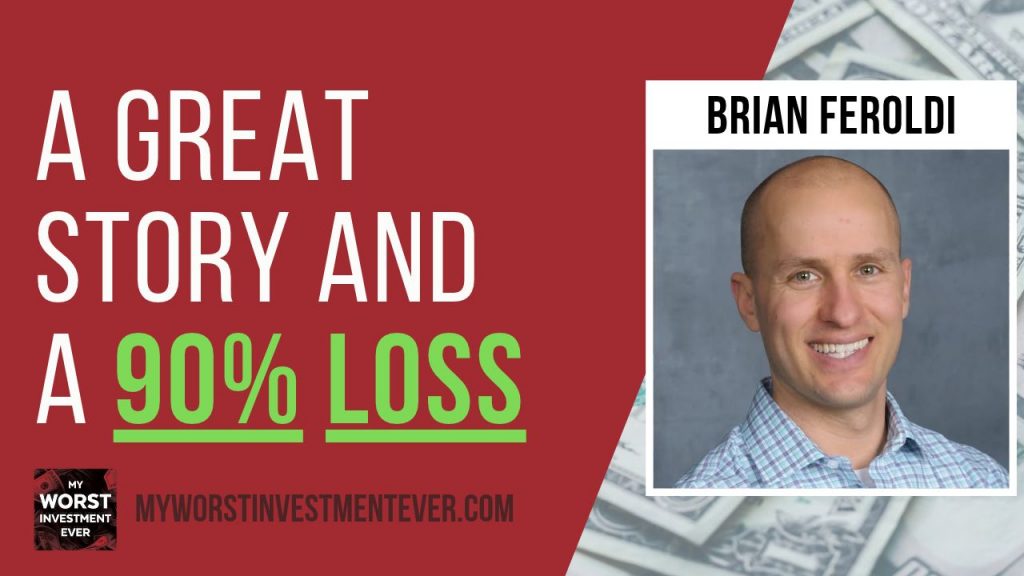
Ep828: Brian Feroldi – A Great Story and a 90% Loss
Listen on
Apple | Spotify | YouTube | Other
Quick take
BIO: Brian Feroldi is a financial educator, YouTuber, and author. His career mission statement is “to demystify finance.”
STORY: Brian invested heavily in Vivos Therapeutics because he believed its proposed sleep-apnea treatment addressed a significant problem with an attractive business model. But he underestimated how difficult it could be for a tiny, unprofitable company to raise capital. He ultimately suffered a loss exceeding 90%.
LEARNING: Be extremely careful with micro caps. Pay more attention to the management team’s execution above anything else.
“Don’t tell me a good story. Prove it with your past performance.”
Brian Feroldi
Guest profile
Brian Feroldi is a financial educator, YouTuber, and author. His career mission statement is “to demystify finance.” He loves to help other people do better with their money, especially their investments. He has written more than 3,000 articles on stocks, investing, and personal finance for The Motley Fool.
Brian Feroldi returns to My Worst Investment Ever with a new mistake. During his previous appearance in Episode 657: Be Careful When Trading Options, Brian discussed Kinder Morgan and how leveraged options magnified his losses.
Worst investment ever
Brian’s latest mistake involved Vivos Therapeutics, an investment that changed how he thinks about microcap stocks, access to capital, and management execution. Brian was attracted to a proposed solution to a problem he believed affected many people: sleep apnea.
Vivos’s pitch involved an oral appliance intended to change the airway rather than require lifelong reliance on a CPAP machine. A CPAP machine (Continuous Positive Airway Pressure machine) is a medical device that helps people who have sleep apnea breathe more easily while sleeping. This treatment proposition was what attracted him—not a guarantee of clinical or commercial success.
The potential business model also appealed to him. He liked that the company had found a way for providers to make money by recommending the product. Brian saw several appealing elements coming together: a significant patient problem, an innovative treatment proposition, and a financial incentive for providers to offer it. To him, the opportunity looked unusually attractive because the company was still so small.
A small valuation made the upside look enormous
Brian recalls Vivos being worth approximately $70 million when he invested. The idea that he could 10x his investment convinced him to buy very heavily. He even told his friends and family. The investment story was compelling. However, Brian had not sufficiently tested whether the company could finance the time and effort needed to make that story work.
The major mistake: treating a micro-cap like a large cap
Brian had no problems getting in. His investing mindset is not to worry about trading volumes, as he is a long-term investor. So he planned to be in the company for the long term.
Here’s the major mistake that Brian made.
Most of his portfolio is in companies worth $5 billion or more. Those companies have enough liquidity and enough market cachet that, if they need capital, they can easily go to market to raise it.
Now, Vivos was unprofitable when Brian bought it. He knew that ahead of time. He also knew that raised the risk profile. But to his mind, this was just like all his other investments; if this company was unprofitable, it could raise capital from the markets. What Brian got wrong was that when you are a micro cap, raising capital from the markets is substantially harder than it is for the big boys.
How the death spiral unfolded
Vivos was burning a few million dollars a quarter. Nothing in the grand scheme of things for most large-cap companies. But when compared to the company’s market cap, that was actually a significant amount of money.
As the company struggled to gain traction with this product, its stock price plummeted, making raising capital harder. So, the company entered a death spiral that made its market cap decline. At the same time, it needed more money to fund its losses.
Brian listened to Vivo’s conference calls, and the management team always told a good story about the projects they were working on and what was happening. They had all these exciting things in development. Unfortunately, Brian focused on what the company might become while underestimating how difficult it would be to finance the journey. He took a loss of more than 90% on this stock.
Lessons learned
- Be extremely careful with micro caps. Liquidity and access to resources are an entirely different ballgame with small businesses than it is with large caps.
- Don’t reject every unprofitable business; instead, stop treating future potential as a substitute for observable progress.
- Judge management on their execution. It doesn’t matter if a management team tells a good story, has great Glassdoor reviews, is considered shareholder-friendly, or invests in most of the stock themselves. What matters most is their performance track record.
Andrew’s takeaways
- Revenue growth can help a small company gain recognition.
- Examine the trajectory rather than stop at the label “unprofitable.”
- Limited analyst coverage makes expectations harder to judge.
No.1 goal for the next 12 months
Brian’s goal for the next 12 months is to continue adding features to Stock Simplifier so that it’s the only source you need to research stocks.
Connect with Brian Feroldi
Andrew’s books
- How to Start Building Your Wealth Investing in the Stock Market
- My Worst Investment Ever
- 9 Valuation Mistakes and How to Avoid Them
- Transform Your Business with Dr. Deming’s 14 Points
Andrew’s online programs
- Valuation Master Class
- How to Start Building Your Wealth Investing in the Stock Market
- Finance Made Ridiculously Simple
- FVMR Investing: Quantamental Investing Across the World
- Become a Great Presenter and Increase Your Influence
- Transform Your Business with Dr. Deming’s 14 Points
- Achieve Your Goals
Connect with Andrew Stotz:

About the show & host, Andrew Stotz
Welcome to My Worst Investment Ever podcast hosted by Your Worst Podcast Host, Andrew Stotz, where you will hear stories of loss to keep you winning. In our community, we know that to win in investing you must take the risk, but to win big, you’ve got to reduce it.
Your Worst Podcast Host, Andrew Stotz, Ph.D., CFA, is also the CEO of A. Stotz Investment Research and A. Stotz Academy, which helps people create, grow, measure, and protect their wealth.