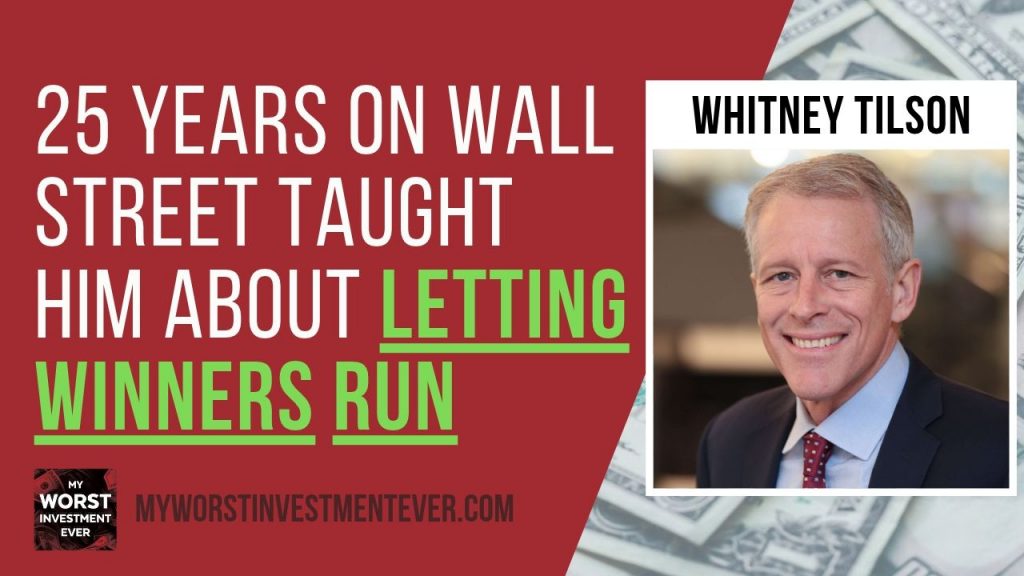
Ep827: Whitney Tilson – 25 Years on Wall Street Taught Him About Letting Winners Run
Listen on
Apple | Spotify | YouTube | Other
Quick take
BIO: Whitney Tilson is Editor of Stansberry Research, which provides advice, commentary, and in-depth research and analysis to help people become better investors. The business has more than 100,000 paid subscribers.
STORY: Whitney lost approximately 500% on a Tesla short position. But he considers selling Netflix too early an even bigger mistake. Although he made roughly seven times his money, he missed much of the extraordinary growth that followed.
LEARNING: The hardest skill in long-term investing isn’t finding the next great company. It’s having the discipline to keep holding the one you already found, long after the easy, comfortable gains have already been banked.
“The only thing I had to do was hold the two big winners. I got stupid and didn’t let my winners run.”
Whitney Tilson
Guest profile
Whitney Tilson is Editor of Stansberry Research, which provides advice, commentary, and in-depth research and analysis to help people become better investors. The business has more than 100,000 paid subscribers.
Whitney founded and ran a number of hedge funds for nearly two decades, and he ran for mayor of NYC.
Sign up for his free Investing Daily at Whitney Tilson’s Daily, where he gives financial advice to average Americans to help them make profitable long-term investment decisions and avoid the endless scams and promotions in the market.
Worst investment ever
Whitney’s worst investment wasn’t really about which stock he picked. In 2013, Whitney was short Tesla. He had seen another ambitious electric-vehicle venture, Better Place, fail and believed Tesla faced serious financial and execution risks. Tesla, however, was just days from running out of cash before it launched the Model S, and the launch succeeded. Whitney says he was too slow to recognize that the business had changed.
The stock tore against Whitney’s short for more than a year. What began as a position representing roughly 1%–1.5% of his portfolio generated a loss of approximately 500% on the short position—not on his entire portfolio.
The phone call that ended the Tesla short
What finally got him out wasn’t a chart. It was a phone call. His cousin, a Stanford engineer, put him in touch with two of Tesla’s top battery and automotive engineers, who told him the company was roughly six years ahead of every other automaker on everything related to electric vehicles. Whitney covered his short that day, at a steep loss, and admits he should have flipped around and gone long instead.
Netflix: from short seller to believer
A couple of years before the Tesla short, he had also been short Netflix and gotten badly burned, so badly that he published a public 18-page essay explaining why he was short the stock.
Netflix co-founder Reed Hastings, whom Whitney knew from serving together on charter-school boards, published a friendly rebuttal days later and invited Whitney out to California to talk it through in person. Whitney left that meeting and immediately covered his Netflix short.
A year and a half later, Netflix’s stock had collapsed by 75% to a $3 billion market cap, exactly as his original short thesis had predicted. Rather than re-shorting, Whitney now respected Hastings and the business.
In October 2012, he went long instead, publicly comparing Netflix to Amazon a decade earlier: same customer growth, same revenue trajectory, but a company that was actually profitable and debt-free. He predicted Netflix could be “this decade’s Amazon,” a 20-bagger in the making.
Right call, wrong nerve: selling a hundred-bagger at seven times
Whitney was dramatically underestimating his own prediction. Split-adjusted, Netflix went from roughly $8 to $800 a share over the following eight years, a hundredfold return. Whitney didn’t stay for the ride.
After the stock doubled, he sold half. After it doubled again, he sold half of what remained, and exited not long after. He walked away with about seven times his money, which sounds like a win until you consider what patience alone would have delivered. “I left a 12-bagger on the table,” he says of the gains still to come in Netflix’s next five years alone.
Lessons learned
- Only buy something or make an investment decision when it’s blindingly obvious and screaming at you.
- Index funds beat almost all active money managers because they let their winners run.
- Build the core of your portfolio around low-cost index funds,
- Understand the downside before entering a position. A short sale can lose multiples of the initial position’s value, making it fundamentally different from an ordinary unleveraged stock purchase.
Andrew’s takeaways
- When something is really exciting and enticing, bet a little on it and track it as you do your research.
Actionable advice
Never short or buy a put. Keep a long-term horizon and don’t wildly over-diversify; make as few trades as possible.
Whitney’s recommendations
Whitney recommends his book, The Art of Playing Defense: How to Get Ahead by Not Falling Behind, built around avoiding the handful of calamities, financial, relational, and otherwise, that can derail an otherwise good life.
No.1 goal for the next 12 months
Whitney’s goal for the next 12 months is to avoid calamities that can derail his life.
Parting words
“All these apps—Wall Street, Robinhood, et cetera—are just filled with the world’s smartest people conspiring to suck you into things that will take all of your money. I love that you’re trying to teach people how to avoid these traps.”
Whitney Tilson
Connect with Whitney Tilson
Andrew’s books
- How to Start Building Your Wealth Investing in the Stock Market
- My Worst Investment Ever
- 9 Valuation Mistakes and How to Avoid Them
- Transform Your Business with Dr. Deming’s 14 Points
Andrew’s online programs
- Valuation Master Class
- How to Start Building Your Wealth Investing in the Stock Market
- Finance Made Ridiculously Simple
- FVMR Investing: Quantamental Investing Across the World
- Become a Great Presenter and Increase Your Influence
- Transform Your Business with Dr. Deming’s 14 Points
- Achieve Your Goals
Connect with Andrew Stotz:

About the show & host, Andrew Stotz
Welcome to My Worst Investment Ever podcast hosted by Your Worst Podcast Host, Andrew Stotz, where you will hear stories of loss to keep you winning. In our community, we know that to win in investing you must take the risk, but to win big, you’ve got to reduce it.
Your Worst Podcast Host, Andrew Stotz, Ph.D., CFA, is also the CEO of A. Stotz Investment Research and A. Stotz Academy, which helps people create, grow, measure, and protect their wealth.