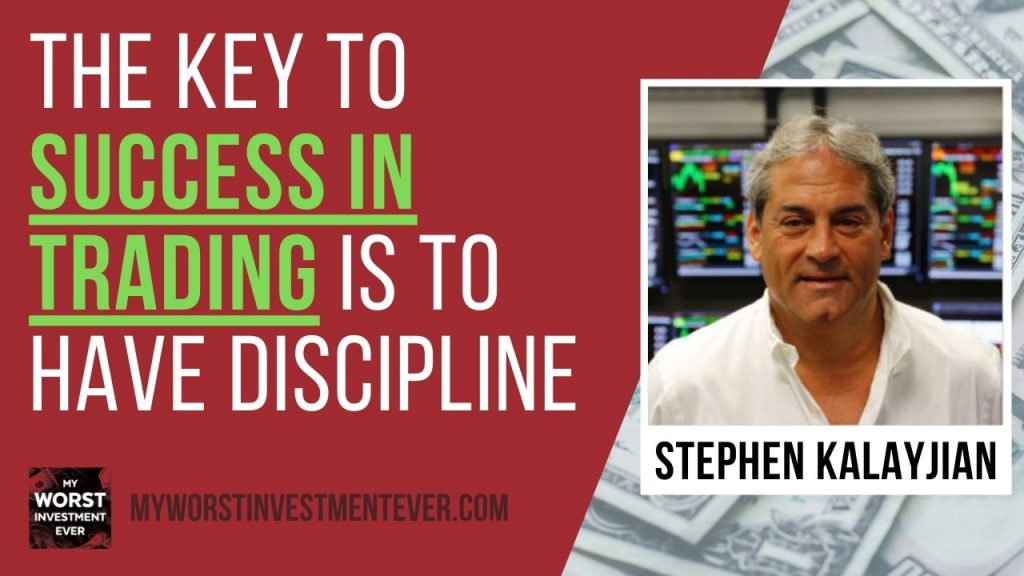
Ep250: Stephen Kalayjian – The Key to Success in Trading Is to Have Discipline
Listen on
Apple | Overcast | Stitcher | Spotify | YouTube | Other
Quick take
BIO: Stephen Kalayjian is a Chief Market Strategist and Co-Founder of Ticker Tocker, a firm that researches and develops software to help identify trends, reversals, patterns, and divergences in the marketplace for all asset classes and time frames.
STORY: Stephen once risked his entire $3,000 savings on a call option trade at his father’s friend’s brokerage. Unfortunately, that trade went bad. He summed up his experience of loss into five core values—consistency, discipline, confidence, patience, and passion—with discipline at the heart of his approach.
LEARNING: Never average down on a losing trade and always preserve capital. No trade is bigger than the market, and cutting losses early is crucial.
“If you’re gonna invest or trade, you have to have discipline.”
Stephen Kalayjian
Guest profile
Stephen Kalayjian, Chief Market Strategist and Co-Founder of Ticker Tocker, has over 30 years of experience in the industry trading stocks, futures, and currencies, having begun his career at the American Stock Exchange in 1983.
In 2005, Stephen founded his firm to research and develop software to help identify trends, reversals, patterns, and divergences in the marketplace for all asset classes and time frames. Stephen seeks to generate high alpha trading ideas throughout the day. He and his team employ technical analysis through utilizing the proprietary charting software he developed on Ticker Tocker to forecast the market.
Stephen has traded nearly 2 billion shares over his career.
Worst investment ever
A teenage trader with a lifetime of savings on the line
Stephen Kalayjian’s worst investment happened at the very beginning of his career, long before he became a seasoned market strategist. At just 19 years old, fresh out of high school, he had saved a little over $3,000 by working thousands of hours doing anything he could to earn money, cutting grass, washing cars, cleaning windows, and hauling out garages. To Stephen, that money represented years of sweat, discipline, and ambition.
Eager to make his mark on the trading floor, he opened a brokerage account through a family connection and committed nearly all his savings to a single idea. In August 1983, he bought call options on a well-known blue-chip stock, convinced the price would rise. What Stephen didn’t understand yet was time decay, premium depreciation, or the brutal mechanics of options when a trade moves against you.
Panic, pride, and doubling down
As the stock began drifting lower, Stephen’s confidence gave way to panic. Instead of cutting the loss, he averaged down, buying more call options as prices fell. Each purchase felt like a chance to recover, but in reality, it only deepened the hole. By Thanksgiving, the position was essentially worthless. Stephen vividly remembers standing on the trading floor, head in his hands, watching months of hard work evaporate.
By Christmas, he was ‘broke beyond broke.’ The emotional toll was intense, with every tick lower feeling like a personal failure, showing how crucial emotional control is in trading. The stress lingered for months, revealing that without discipline and risk management, losses can become overwhelming.
A narrow escape and a hard truth
He managed to sell enough contracts to salvage a thin margin and close the position, but the lesson was clear and unforgettable: never average down on a losing trade. Discipline in sticking to your plan is vital to avoid deepening losses.
That painful experience became a defining moment. Stephen realized that effort, intelligence, and passion mean nothing without discipline. The market does not reward stubbornness or pride, and no trader is bigger than the market itself.
Lessons learned
- Stephen’s first significant loss reshaped how he approached trading forever. He learned that being wrong is not the problem; refusing to accept it is.
- All traders will lose sometimes, but what makes the difference is getting to grips with it and moving on to the next one. Accepting a losing trade and moving on to the next one was far more important than covering a losing position, Stephen learned.
- Preservation of capital became Stephen’s north star, and discipline became non-negotiable. He saw firsthand how quickly hard-earned money disappears when emotion replaces strategy.
- Stephen learned that throwing good money after bad only adds to your loss. When you are against a trade, take the loss and exit immediately. Do not average down.
- Over time, Stephen also learned humility. He watched powerful stocks collapse, companies disintegrate, and traders cling to positions out of hope rather than logic. The lesson was simple but unforgiving: the market has its own rules, and ignoring them comes at a steep cost.
Andrew’s takeaways
Andrew draws several universal lessons from Stephen’s experience:
- Discipline is survival. If you treat trading like gambling, the odds will eventually catch up with you. Risk management isn’t optional; it’s the seatbelt that keeps you alive when markets crash.
- He concurs that stop-losses are crucial. When trading, use protective exits on all positions.
- Capital preservation. The market owes you nothing, and losses are permanent if you don’t manage risk.
- Andrew also highlights emotional discipline, noting that many traders refuse to sell winners until they turn into losers. The ability to take profits, accept losses, and move on separates professionals from amateurs.
Actionable advice
- Begin every trade with a plan that defines entry, exit, and risk. Set stops in advance and respect them without exception.
- Position sizing matters just as much as trade selection, because even good ideas can fail. Put a stop-loss on each position and commit to it 100%.
- Commit to continuous learning. Reviewing past trades, keeping a journal, and studying mistakes turn losses into education rather than trauma.
- Most importantly, patience and discipline must outweigh the urge to act. There will always be another trade, but there may not be another account if you blow up this one.
No. 1 goal for the next 12 months
Stephen’s number one goal for the next 12 months is to help others learn the right way to trade. After nearly four decades in the markets, he sees education and discipline as life-changing tools. Through his work, he aims to guide traders away from costly mistakes and toward strategies rooted in consistency, patience, and respect for risk.
Connect with Stephen Kalayjian
Andrew’s books
- How to Start Building Your Wealth Investing in the Stock Market
- My Worst Investment Ever
- 9 Valuation Mistakes and How to Avoid Them
- Transform Your Business with Dr.Deming’s 14 Points
Andrew’s online programs
- Valuation Master Class
- The Become a Better Investor Community
- How to Start Building Your Wealth Investing in the Stock Market
- Finance Made Ridiculously Simple
- FVMR Investing: Quantamental Investing Across the World
- Become a Great Presenter and Increase Your Influence
- Transform Your Business with Dr. Deming’s 14 Points
- Achieve Your Goals
Connect with Andrew Stotz:

About the show & host, Andrew Stotz
Welcome to My Worst Investment Ever podcast hosted by Your Worst Podcast Host, Andrew Stotz, where you will hear stories of loss to keep you winning. In our community, we know that to win in investing you must take the risk, but to win big, you’ve got to reduce it.
Your Worst Podcast Host, Andrew Stotz, Ph.D., CFA, is also the CEO of A. Stotz Investment Research and A. Stotz Academy, which helps people create, grow, measure, and protect their wealth.