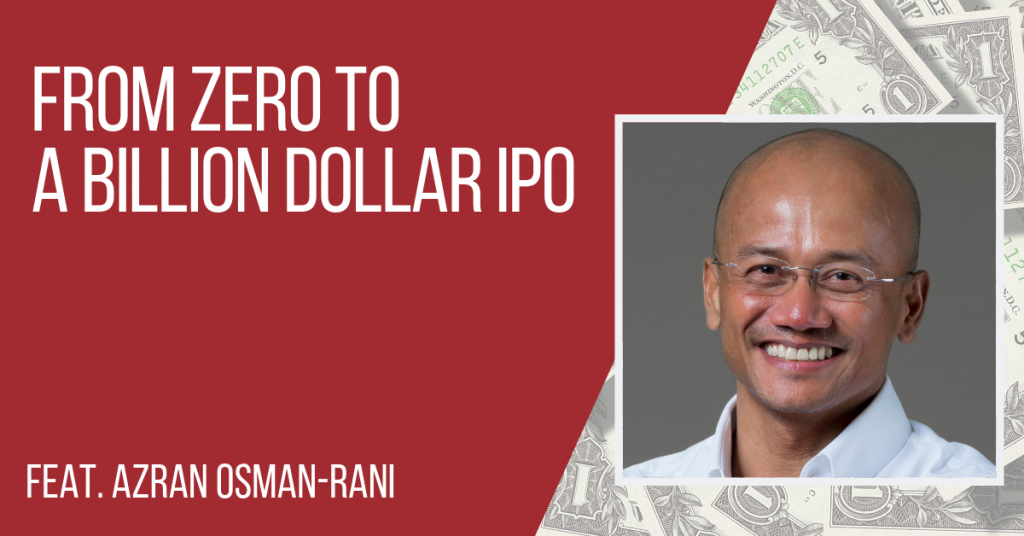
Ep76: Azran Osman-Rani – From Zero to a Billion Dollar IPO
Listen on
Apple | Listen Notes | Spotify | Other
Guest profile
BIO: Azran Osman-Rani is the founding CEO of Naluri, a digital health technology company. He previously pioneered the long-haul, low-cost airline model as the founding CEO of Air Asia X.
STORY: Azran took a huge loan to buy extra shares in Air Asia X after a successful IPO. However, three airline disasters caused the shares to tank, leaving him with a seven-digit net cash loss.
LEARNING: Be very wary of what banks or investment bankers tell you or advise you to do. Have a backup plan or alternative way to survive or recover from loss. Value is created through products and services.
“I ended up with a seven-digit net-cash loss … and eventually had to part company with the board in that journey. So it was a very, very tough and painful, financial ending … But you know, I learned an invaluable amount from that experience, and I wouldn’t have traded it for anything.”
Azran Osman-Rani
Guest profile
Azran Osman-Rani is the founding CEO of Naluri, a digital health technology company that provides a cost-effective and accessible digital health psychology service to help users adopt healthier lifestyle behavior changes. He is active in the internet technology space and is a co-founder, investor, and advisor to iflix, MoneyMatch, Cognifyx, and Yellow Porter. He was previously the CEO and group COO of iflix – a disruptive Internet TV-and-video-on-demand service that was launched in Kuala Lumpur, Malaysia, in May 2015. It now operates across more than 30 markets in Asia, the Middle East, and Africa and has 700 employees, all in less than three years from its launch. Previously, Azran pioneered the long-haul, low-cost-airline model as the founding CEO of Air Asia X. He led the airline’s growth from start-up to US$1 billion in revenue, 2,500 employees, and a public listing, all in just six years, breaking many low-cost airline industry conventions and introducing innovations along the way.
Worst investment ever
Azran has built an extraordinary career by taking on the impossible. As the founding CEO of AirAsia X, he pioneered the long-haul low-cost airline model—something the entire industry said couldn’t be done. He later led iflix’s explosive growth across 30 markets and is now tackling Malaysia’s obesity crisis through digital health. But beneath these impressive achievements lies a financial disaster that cost him seven figures in cash and taught him lessons no business school could offer.
The AirAsia X rollercoaster
When Tony Fernandes, CEO of AirAsia, wanted to create a long-haul low-cost airline, AirAsia itself refused—they didn’t believe it was viable. Tony needed someone “gullible enough” to try. He found Azran. But there was a catch: Tony didn’t believe in stock options. “If things go south, you walk away,” Tony told him. “I need you to feel the same pain as shareholders.”
Tony’s solution? Azran would empty his savings and pension fund, and Tony would arrange a bank loan to help him buy equity. As a percentage of his net worth, Azran’s stake was far larger than the billionaire founders’. It was a terrifying bet, but Azran believed in the principle: if you’re going to lead a startup, you must have skin in the game.
The trial by fire
The journey from startup to IPO was six years of near-death experiences. The 2008/2009 global financial crisis hit. Banks deserted. Governments turned against them. Oil prices swung from $80 to $147 a barrel and back to $32—all within months.
At one point, a fuel hedging contract with Lehman Brothers could have wiped them out with a claim four times their entire capital. Only Lehman’s collapse saved them.
The triumph: 6x return
Despite everything, AirAsia X became the first long-haul low-cost airline to list on the public market. Institutional investors validated the model. For those who invested at par value, it was a 6x return. Azran had defied the odds.
The fatal move: doubling down with leverage
Then came the IPO. In Malaysia, CEOs receive special allocations of shares. The investment bank had a compelling pitch: “Double your stake using your first set of shares as collateral. Show investors you believe in the IPO price.” Azran agreed, taking on another loan of equal size.
Now he carried an enormous debt—but the future looked bright.
The triple black swan
The IPO raised $300 million, and the strategy was clear: dominate. AirAsia had taught them that you must be double the size of your next competitor. So they bet the entire proceeds on a 50% fleet expansion in 2014.
Then the unthinkable happened. Not one, not two, but three airline disasters struck: MH370, MH17, and QZ8501. The hardest-hit markets were China and Australia—precisely the markets where Azran had consolidated pre-IPO, accounting for 70% of its business.
Tourist arrivals crashed by over 20%. Capacity had increased 50%. The bloodbath was inevitable.
The downward spiral
The share price collapsed. The bank began making margin calls. As CEO, Azran couldn’t be seen selling shares, so he poured more cash from savings to protect his position.
It was futile.
The bank sold everything—not just the IPO shares, but his original shares too. Azran ended up with a seven-figure net cash loss. The paper loss was multiple times worse. Eventually, he parted ways with the board amid intense pressure.
Lessons learned
- Be wary of bankers bearing gifts: Investment bankers earn fees whether you win or lose. Their advice serves them, not you. The same banks that encouraged his IPO leverage would later call in his loans.
- Fuel hedging doesn’t reduce risk: Every airline hedges to “take out volatility.” But the house always wins. The real competitive advantage? Being the world’s most fuel-efficient airline, you win at any oil price.
- Always have a backup plan: When disaster struck, Azran proposed a radical pivot: lease 50% of their new planes to other airlines for hard currency, even if it meant operational chaos. He failed to convince the board. The lesson: prepare contingency plans before a crisis hits.
- Rethink board governance: Post-IPO boards become conservative. Independent directors lack appetite for radical moves. Organizations need mechanisms for faster pivots, not quarterly approval cycles.
- Leverage is a silent killer: That second loan, using shares as collateral, transformed a paper loss into a cash catastrophe. Never borrow against volatile assets.
Andrew’s takeaways
- The damage of leverage: In business and life, there are only two real financial risks: debt and currency. Run a business without debt, and you eliminate enormous risk. Andrew’s friend in Thailand runs a $600 million company with zero debt and 20% cash on the balance sheet—a lesson learned from nearly losing everything in 1997. If Azran had followed two simple principles—stay debt-free and diversify—he might have kept his 6x gains. But leverage turned victory into ruin.
- Never listen to Financial People: Investment bankers, analysts, and finance professionals have never run a company. They sit on the sidelines, eating popcorn and giving advice with zero skin in the game. They make money from getting you to act, not from your success.
- Finance Adds No Value: Value is created on the asset side of the balance sheet: better products, better services, more fuel-efficient planes, committed people. Finance is merely a supporting tool for management decisions. CEOs who mistake financial maneuvering for value creation are heading for disaster.
Actionable advice
There is always a Plan B, C, and D. Indecision is the worst decision. But you must build the capacity to pivot quickly—and that means designing governance that allows rapid strategic shifts, not quarterly board approvals.
No.1 goal for the next 12 months
Azran’s number one goal for the next 12 months is to complete several clinical trials to determine how digital interventions can lead to healthier outcomes and to devise a formula that allows him to scale to other markets.
Parting words
“It’s all about looking forward and not looking back. There’s a lot ahead of us. All the best to everyone.”
Azran Osman-Rani
Connect with Azran Osman-Rani
Andrew’s books
- How to Start Building Your Wealth Investing in the Stock Market
- My Worst Investment Ever
- 9 Valuation Mistakes and How to Avoid Them
- Transform Your Business with Dr.Deming’s 14 Points
Andrew’s online programs
- Valuation Master Class
- The Become a Better Investor Community
- How to Start Building Your Wealth Investing in the Stock Market
- Finance Made Ridiculously Simple
- FVMR Investing: Quantamental Investing Across the World
- Become a Great Presenter and Increase Your Influence
- Transform Your Business with Dr. Deming’s 14 Points
- Achieve Your Goals
Connect with Andrew Stotz:

About the show & host, Andrew Stotz
Welcome to My Worst Investment Ever podcast hosted by Your Worst Podcast Host, Andrew Stotz, where you will hear stories of loss to keep you winning. In our community, we know that to win in investing you must take the risk, but to win big, you’ve got to reduce it.
Your Worst Podcast Host, Andrew Stotz, Ph.D., CFA, is also the CEO of A. Stotz Investment Research and A. Stotz Academy, which helps people create, grow, measure, and protect their wealth.