
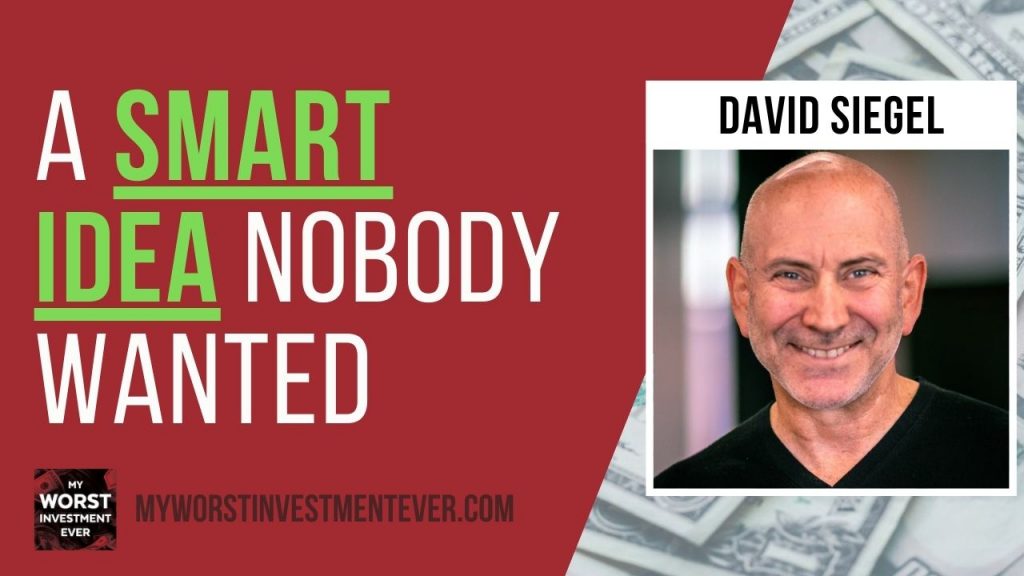
Ep816: David Siegel – A Smart Idea Nobody Wanted
Listen on
Apple | Listen Notes | Spotify | YouTube | Other
Quick take
BIO: David Siegel is a Silicon Valley entrepreneur who has founded more than a dozen companies. He has written five books on technology and business, was once a candidate for the dean of Stanford Business School, and is now an AI thought leader leading an AI startup he hopes will pave the way for the agentic economy.
STORY: David invested heavily in launching a longevity coaching business, believing people would pay to extend their lives through lifestyle change. Despite strong science, personal results, and significant marketing spend, demand proved nearly nonexistent.
LEARNING: A great idea without real demand is still a bad investment.
“There will be many new problems, and whenever there are new problems, there’s a new economic opportunity for many people.”
David Siegel
Guest profile
David Siegel is a Silicon Valley entrepreneur who has founded more than a dozen companies. He has written five books on technology and business, was once a candidate for the dean of Stanford Business School, and is now an AI thought leader leading an AI startup he hopes will pave the way for the agentic economy.
Worst investment ever
After years of building companies and studying major technological shifts, David found himself pulled deeply into the longevity movement. This wasn’t casual curiosity. He read more than 20 books, radically transformed his lifestyle, and developed a deep understanding of insulin resistance, nutrition, exercise, and long-term health.
The results were personal and visible. David was fit, disciplined, and energized. The idea that science could help people live 10 to 15 years longer, with a higher quality of life, felt not only possible but urgent. Helping others do the same seemed like a natural next chapter.
Turning passion into a business
Confident in both the science and his own experience, David decided to turn longevity coaching into a scalable business. His target audience was people in their 50s and 60s, individuals who were pre-diabetic or heading toward serious health issues and stood to benefit the most from early intervention.
He approached the venture like a seasoned entrepreneur. He built funnels, ran Facebook ads, spoke at retirement communities, and spent months on discovery calls explaining how lifestyle changes could dramatically reduce the risk of cancer, Alzheimer’s, and diabetes.
This wasn’t guesswork; it was disciplined execution.
The painful reality check
Then reality set in.
Despite spending over $100,000 on advertising and investing countless hours in conversations, demand was almost nonexistent. People listened. They nodded. They agreed the logic made sense. Then they walked away.
Many believed the healthcare system would save them. Others hoped for a pill instead of discipline. Even those clearly facing insulin resistance weren’t willing to make sustained lifestyle changes.
The most sobering realization wasn’t about marketing or pricing. It was this: most people don’t actually want to live longer if it requires consistent effort.
Accepting the loss
In the end, only about one percent of the people David spoke to were already doing the work and didn’t need coaching. Everyone else opted out, fully aware of the consequences.
The investment failed not because the science was wrong, but because the market wasn’t there. David ultimately gave the information away for free and walked away from the business, having learned an expensive but clarifying lesson about belief versus demand.
Lessons learned
- Even the most compelling solution will fail if it requires behavior that people are unwilling to change.
- Logic, evidence, and outcomes don’t matter if the market emotionally resists effort.
- A great idea without real demand is still a bad investment.
Andrew’s takeaways
- Andrew highlights that people consistently search for shortcuts rather than long-term solutions. Whether in health or investing, most people prefer convenience over discipline, even when the stakes are life-altering.
Actionable advice
Before scaling any idea, test for real demand, not polite interest. Ask whether people are willing to pay, change their habits, and put in effort. If behavior change is central to your offering, validate that reality early or risk learning the hard way.
David’s recommendations
David encourages understanding your own health data, particularly insulin resistance, through proper testing, such as an oral glucose tolerance test. While the business failed, the knowledge remains powerful and freely available for those willing to act.
Parting words
“Keep looking for new problems that didn’t exist six months ago and jump in after them.”
David Siegel
Andrew Stotz 00:01
Hello fellow risk takers, and welcome to my worst investment ever. Stories of loss. To keep you winning in our community, we know that to win in investing, you must take risks, but to win big, you've got to reduce it. Ladies and gentlemen, I want to thank you for joining this mission, and today we have a third time guest, David Siegel, who's coming on, and you can hear his worst investment ever story in Episode 98 you can also hear his and my story and discussion about climate and ESG and all of that stuff on episode 644, but recently, David has been working on some interesting stuff related to AI. In fact, I want to call this episode, drop everything. This is what you need to do now with AI.
David Siegel 00:54
David, how are you doing? I'm great. Great to see you again. Andrew, always fun to chat.
Andrew Stotz 01:00
Yeah, I'm excited. And we had, we had a fun one when we talked about, don't reduce climate change to a score.
David Siegel 01:08
I think, fortunately, the winds are starting to blow in the right direction. The climate is starting to change. So this
Andrew Stotz 01:17
is not a traditional episode where you're going to go through necessarily. You know the whole story of your worst investment ever, because we're gonna, we're gonna get, we're gonna go through some other interesting stuff. But I think you had, you had a story to tell you were mentioning before
David Siegel 01:30
we got a recent bad investment story. Apropos, I spent the last two years really getting caught up and toward the front of the longevity movement. Okay, having read about 20 books on longevity and really excited about helping people live longer, I am. I'm kind of a gym fiend, and I'm in great shape, and I've changed my whole life and routine, and I've helped a bunch of other people. And so I thought I'd just go to market with a coaching service and help people live longer. People are in their 50s and up, live 1020, years longer than they would otherwise, which I can't. I can help anybody now. Your mom is a little already in her what? Mid age 87 right? So she doesn't want to live any longer, yeah. So people who are a little younger than that. I have some clients, many clients in their 60s and 70s. And I just decided to go to market and run Facebook ads and, you know, build funnels and talk to a bunch of people and see if I could turn this into a business and scale it up. And I've made a lot of speeches at many retirement communities. And it turns out, and I learned a very important and expensive lesson, that is, most people don't want to live longer. I can help anybody live 1015, years longer, and there's just very remarkably little demand.
Andrew Stotz 02:54
And would you say that that's the case with people who are older saying that like a 70 or 80 year old? Are you
David Siegel 03:00
saying, oh no. I'm talking about people in their 50s and 60s saying, Oh, the medical system will take care of me. No, I'm good. I'm pre diabetic. You know, people who will be diabetic in five to 10 years, you know, would you like to get off that and not, maybe not inject yourself with insulin every day? Nah, I'm fine.
Andrew Stotz 03:21
Yeah, it's definitely people just want to. They want a pill.
David Siegel 03:25
They want a magic pill. Yeah, ozempic is one of the best selling products of all time. It is such an amazing product because you have to keep paying $800,000 a month forever to not lose what you've gained. And it's not that great, and it's not very healthy, and nobody changed. Nobody wants to change his lifestyle.
Andrew Stotz 03:43
Yeah, when I was young, someone said, there are no shortcuts.
David Siegel 03:47
It's a disaster, and people don't get that. They now have a choice that they could if they wanted to change their lifestyle and put effort into it. They really could extend their lives, but there's really no demand. So I pivoted to AI interesting.
Andrew Stotz 04:02
Now, before you save no demand. I mean, how, how bad was it? Were you deep into it and invested a lot of time money?
David Siegel 04:10
I put $100,000 and more into this, in Facebook ads. I talked with people for months and months, Discovery calls, and either they're already doing it, which 1% kind of are, and then the rest of them are just saying, No, I don't mind if I get cancer or Alzheimer's or whatever. It's fine. I'm not going to pay anybody to help me do this. No, I'm not going to put the effort in. And if you want to learn to all my information's online, you can go to infinitegame of life.com and learn for yourself. It's all there. I just gave it away for free.
Andrew Stotz 04:44
And what, what would you be say is, from all of your that and your years of experience, like, what's, what's a tip
David Siegel 04:51
you know for, oh, the number one thing is, you need to know whether you're insulin resistant or not. Doctors don't talk about this insulin insulin resistance is the platform on. Which most degenerative disease is built so cancers, Alzheimer's, neurodegeneration, it's all built on insulin resistance. And so you've got to know your insulin resistant number, which is going to come from an oral glucose tolerance test. Most people can get an A, 1c on their blood test that will give them an indication, but if, basically, if you're overweight, you need to get an oral glucose tolerance test, and then you need to change your diet and behavior, and it's both diet and exercise that will get you out of insulin resistance, and that will add 510, 15 years to your life and much better quality years and it's not that hard, interesting.
Andrew Stotz 05:46
Yeah, I've written it down, and I know for the listeners and reviewers, make sure you got that down. It's an OGTT, right?
David Siegel 05:53
It's all explained at infinite game of life.com.
Andrew Stotz 05:57
Perfect, and I'll have a link to that in the show notes. Actually, you're capturing me on the fourth day of a water only fast that's a big one that I do once, once a year, once every maybe six months. This one I did a little differently, where the three days preceding the fast, I did a three day juice fast prepared by the local juice place, and they have, like, a mix of juices. You take six different small bottles throughout the three days. So I had already stopped consuming, you know, solid food, and then I went through it, it made a lot easier. Sometimes getting doing a water only fast can be like, so it hits you really hard, you know. But yeah, when I kicked it off, which was on Monday, now it's Thursday. You know, it's been, it's been much more smooth. So I always do that because of the health benefits. It's not a good way to lose weight because you basically
David Siegel 06:50
don't recommend the pre juicing at all. That's carbs, and you're going to be low on protein going into a four day fast. You're already seven days low on protein. So I would say you're past your limit and you're starting to lose muscle. Yeah, day five is when a lean person will start to lose muscle. Day six and seven is when a heavier person will start to lose muscle. Yeah, that, that's a good
Andrew Stotz 07:16
point. And I can see, you know, I,
David Siegel 07:19
I'm, I'm debating about it, what, what it helped me with was just easing into it. But definitely, you could also argue that there's no need to do five days. Three days would bring autophagy. Three days is great. Yeah, so days are great, but now you're getting me to start wanting to eat lunch. David, protein go get yourself a protein shake. You're low on protein right now. Definitely. Okay. Yeah, great. And, and, by the way, just so people know, my recommendation is one gram of protein per day per pound of ideal body weight. So about roughly two grams per kilo of ideal body weight per day, every day. It's a lot and it really helps.
Andrew Stotz 08:01
You know, it's hard to get that. I mean, it is very hard, and particularly as you get older, it's like my ability to bring in a lot of food into my gut is much lower than it was like when I was young. I could just have a
David Siegel 08:13
program for doing that. I have a program for doing that, and also for building bone, because you're losing bone if you're not building bone. Yeah. Well, no, I'm
Andrew Stotz 08:22
the link in the show notes, and that's that's definitely interesting. But let me introduce you to the audience. Not everybody knows you and sir. David is a Silicon Valley entrepreneur who has started more than a dozen companies. He has written five books on technology and business. He was once a candidate to be the dean of Stanford Business School, and is now an AI thought leader, meaning an AI startup that he hopes will pave the way for the agentic economy, and he helps companies convert more traffic into sales for a fraction of the cost of humans. And that's why you got to drop everything, ladies and gentlemen. So tell us what you're doing.
David Siegel 08:58
Well, let's just talk with the big picture companies. Are we? Are we are not. I don't believe we're in a bubble. I don't really believe bubbles ever exist. I think that when you put real money into it, it means you think you're going to make money. And if you'd bought at the top of the tech wreck, at the bottom of the tech wreck, or, sorry, at the top, when you said it was a bubble just before the record, it's end of 1999 you would have had a fantastic return now, would have beaten the S and P Now if you'd bought at the top. So we can't call bubbles when we're in them, and there really aren't any, and we're not in one now, and companies need to drop everything, and that is not going to be relevant to the AI economy in the next six months. So look out six months. Look at all your projects that you're doing that won't be, will be irrelevant, and drop them now, instead of being forced to do it later.
Andrew Stotz 09:54
And when you think about, when I think about AI, you know, I mean, I, I feel like it's my it's. My My lover. I work with her every day. Sometimes she gets me really upset. Do you do fight a little bit? Yeah, sometimes she brings me pleasure. I even at one point wrote to chat GPT and said, I want a refund. This is defective. Yeah, for a month, and then I, I ended up, you know, having to give up and go back on it and, you know, go, re enter the battle. But when you're talking about, like, drop everything in, you know, focus on AI. What is AI? Anyways? I mean, for me, it's like, a, it's a, definitely an editor, yeah. I mean, it does that. But, I mean, you're not talking about that. You're talking about, you know, revolutionizing the business. I'm assuming it's a
David Siegel 10:43
knowledge worker. I'm writing a screenplay with it right now. I've written several business plans, and I always end up rewriting them, but it always gives me the framework and does the homework and does the research and helps me. I've written several articles where I keep asking it to fill in this paragraph, and it does that. And then I put, so I'm the architect, and it's the builder. It's, it's doing, I'd say, I say, use AI first all the time. Get AI to do the hard work for you. So don't abandon it and say, Okay, I got it from here, and I'll do the rest by hand. Keep prompting until you get what you want. You can even, you can even take what you've got, put it into a document, and then say, Now redo this section, because I forget, they'll say, here's a section. And redo the section. Then it'll give you that you keep kind of but at the end of the day, if you have a good one, it'll often have enough memory to spit out the whole thing, right? And you can also ask it to summarize everything you've been doing for the last two days and put it into a summary. Edit that summary down with it, and then get it to regenerate so that whatever it forgot, you can tend to kind of bring back by forcing it to do all that work.
Andrew Stotz 11:53
You used a term that I remember Peter Drucker published in 1965 in the effective executive called a knowledge worker.
David Siegel 12:01
Yeah, yeah. And I'll tell you something funny, because people don't really know this, an LLM large language model, which we mostly use is just predicts the next word. That's all it does. It happens to be very good, and most of those next words are good. You notice that it hallucinates. You can get it to reduce hallucination. And I have a prompting course on my two hour Executive Education course on AI, which you'll link to. It's the reset at my website, the great AI reset. And one of the things people don't know about is something called temperature. You can say set at temp to some value between zero and two. It comes set at one, where you get a lot of hallucinations. But if you want many fewer hallucinations, you can say set at temp point five, and it will give you many fewer hallucinations for a while, until it wears off, or you can get it really go crazy and give you, you know, if you want to do a wild and crazy story that tell it to say, temp equals two, and it'll just take it and run with it. So you can actually modulate that. And there's a lot more you can do in your prompts. I want people to develop a personal prompt and a system prompt that they put in at the beginning of every day. And for example, I say use a Spartan tone. Just by saying those four words, use a Spartan tone. It cuts down on lots of the car garbage. You're going to get out lots of the verbiage.
Andrew Stotz 13:29
And I'm at, I'm at your website, red shift labs.io/reset, and that's the video series, yep, the AI reset video, course. Can you just say what? What people get if they go to this?
David Siegel 13:43
This is a business course. Yep, there's quite a few new ideas here that you won't get anywhere else. There is how ll albums work. There is how agents work. And you can see examples of agents. You can see how a web app works, which is how our web app works. So you'll see a video on that, but we're going to do a quick demo just to show everybody. And then the drop everything section. And then there's a the prompting class, drop everything, and what are the implications for society, and what about the dangers? And then the final one is an essay on AGI, which is the holy grail. When, when one program is the best knowledge worker in the world across all categories. And I have a big essay on why that's a little bit misunderstood, and why humans just aren't as smart as we think we are, and so kind of, as far as I'm concerned, we're basically at AGI already, because the llms aren't that good, but we're worse. And you just has to outrun the bear, not, not you just has to outrun you, not the bear.
Andrew Stotz 14:52
Yeah, and the, if I look at, for instance, my coffee business, you know, it's a factory. It's to B to B business. Supplying hotels, restaurants, coffee shops, offices. I've got a sales team, I've got a management team. I've got a group of workers. We're roasting coffee every day, physically delivering that product, servicing the machine, selling the machines. You know, it's, it's, it's on the ground, you know thing, and already, you know, everybody who can is using AI to help them with their writing, and, you know, with a bunch of stuff. So, you know, that's kind of basics ABC. But when you look at your course, and you look at what you've been talking about, what are the next steps? I mean, I'm not sure if it's that clear to me, how sure.
David Siegel 15:46
Yeah, it's not easy. For example, the back office is going to revolutionize. They're going to be companies that are you're used to a bunch of back office applications that are very brittle. You have to put everything in the right number and everything in place, and then it'll spit out what you want. And with AI, you can just say, Can you fix that? Can you rearrange that? It's going to be much looser. And it will deal with partial data or scrambled up data or unformatted data, and it'll put it all together, so a CRM or your general ledger, or your accounts payable, all that stuff, you'll just talk to it like you talk to an expert who can do that. So it's kind of like having a room full of people who are really good at what they do, white collar workers, and just talking to them and telling them what to do. And we're having conversations say, you know, what can we do to minimize our tax exposure for next year? And it will come back with that. And most of these pack, you know, packages for, you know, back offices are never going to do that. Then you have to talk to some $600 an hour accountant to do that.
Andrew Stotz 16:48
And when I think about my accounting, you know, I have a credible team that closes the books on time every time, every month, and we close the books monthly for 30 years. So, like we, we understand accounting and finance, and basically it's a brutal task, really, when you think about it, the paperwork that's involved, stuff within our accounting system, chasing down all the little things. Yeah, and you know, you know, we have recipes, we have loss, we have this is it properly accounted for? We've got workers. We're allocating costs. I mean, it is a huge bear. And then it's all going to be put into a structured database, exactly. And then from that, we're able to really get an incredible amount of information from it. So it's hard for me to see, for instance, that AI is going to replace that,
Speaker 1 17:38
it'll replace that. I just can't see it. How is that going to happen?
David Siegel 17:43
Absolutely the same way that your people have learned it, it will learn from them, and it will just take it over. That'll be the this is the low hanging fruit. This is going to be the easy stuff. I know it sounds complicated to you, and there's a lot of little things, things to, you know, clean up at the end of every month, but it'll just do that. This is going to be the easy stuff, and harder stuff will be. Will be stuff like cost benefit, should you open another should you take a new account? Should you expand? Should you get a new supplier? You know, should you do capex? You know, bit hard business decisions is going to be trickier, but this blocking and tackling of routine stuff every month is just going to go down in the next 12 months.
Andrew Stotz 18:27
And, yeah, I mean, I would love to think about how we continue to keep our accounting at the cutting edge, because accounting and finance is, you know, the ability to really understand the flowing of blood in the system. Yeah. And, you know? And you could imagine, if a company could really implement that, it would be some competitive advantage at driving down costs, because there's a huge amount of cost spent, particularly in companies that don't have their accounting that strong. So that's one area. What about you
David Siegel 18:55
even better? It'll say, you know, we can manage your debt better. We can get you better. We could look for better interest rates. We could manage your cash flow. Look, we could save a million dollars here, or, you know, there,
Andrew Stotz 19:08
I understand that, where I can put my information into it and say, Help me think about such and such. But the actual compiling of the information, that's hard to see,
David Siegel 19:21
you know, but why? Why am I saying it'll do it because it's such a common need. We're talking about a trillion dollar business, almost. Oh, yeah, yeah, right. If you don't think there's 30 startups doing this, there are more, right? So you're gonna see demos of this, and then, and then you'll go to their website, and you'll say, but my business is different, and it'll have its own AI bot that we'll probably make that'll say, Fine, download all your information, tell me about your system, and I'll just make a demo for you right now, and beat what you've got already, and it'll do that in five minutes.
Andrew Stotz 19:55
Yeah. And then let's talk about I know we're gonna talk. A little bit about sales and all that. But I'd like to talk about marketing, because that's also it's a different thing where, you know, we need to get a clear picture of our avatar and make sure that we got our target market really clear, and then it's about marketing campaigns and all that. And you know, there's so much emotion involved in that and creativity. Is it going to do that in marketing?
David Siegel 20:21
No, it's already done. It's done all what I call the Cialdini mind tricks, all of the teasers, the hooks. This exactly I'm talking I'm mentioning Cialdini for a reason. The you know, Russell Brunson talks about hook story offer, all this stuff has been done. And it can watch Tiktok and Facebook and all these flows for what's trending. And it can make its own ad sets. It can make its own copy, and it can just experiment and do AB tests before you wake up in the morning, it's already knows what's the best mix for that day and what hook is working. And then by the end of the night, it'll, it'll know what to do for the next day.
Andrew Stotz 21:11
And is this just like chat GPT, or is this a specialized
David Siegel 21:15
there's going to be specialized platform for doing this, for sure. Yeah. And there's a lot of is agentic, which means you're, you're coding up a bot that will go out and and scrape and learn and then put databases together of things, and it will manage 100 200 different ad sets, monitor the the effectiveness, get away, get rid of the stuff that's not working, and Just continually do this. So that's that's an agent, which GPT is not, right? GPT is a question answering service.
Andrew Stotz 21:48
And just one of the things that I like about the stock market, or that maybe I don't necessarily like about it, but it's the reality of it is that as soon as a new idea comes out, or a new concept like, I think the Fed's going to reduce interest rates. As an example, everybody trades it as soon as the information gets out. And then the efficiency is gone, the gain is gone, because everything is a relative gain. And so, you know what? And the way people try to get an edge is, you know, to be faster on to an idea, to see a vision of something that other people don't see, invest in that and be right. And then the market catches up. You know, to what extent are we going to live in this world where, yeah, okay, the next 12 months, there's going to be companies that are just going to give up and they're going to get knocked out, but then the ones that remain, they're all going to be applying these same tools, and all of a sudden, we just raised up, and then AI is not as effective as it used to be.
David Siegel 22:42
Hold on. First of all, that's generally true, and we've been living with that for 1000 years. So we're rat we ratchet up the economy, and that's how the economy grows. Second, your edge is no longer. Your ability to execute your edge is how well you know your customer. Your edge is how many interesting experiments you can throw at your customers and measure what their reaction is. It's no longer about focus groups or questionnaires. It's about, you know, coming up with stuff and throwing it in front of them and seeing if they buy. And the more you know about your customers, the more you'll be able to execute easily and get an edge over the other guys, because you have data that they don't, and you may have insights that they don't,
Andrew Stotz 23:31
that will be an edge. And what's the other thing that I see about AI that gets me always wondering is that you said something when you were talking about redshift labs.io, reset, and that is, that's information that you know is not out. There is and people don't know it well. No, AI's already crawled it. They've already watched all of it, and they've brought it all into their Centralized Information System. And, no, it's no longer your great idea. David, unfortunately, it's gone
David Siegel 24:03
kind of first of all, let's understand how they train. They train right now in a big training session that lasts about three months and cost three four months. Cost about a billion dollars. Grok for is just out of training and is now in the reinforcement learning phase. They will ship grok for in the next four weeks, and that sits close to a billion dollars. So grok four will have trained on those but GPT five will not have because GPT five stopped training last June or July, and so it will be in their weights, and I'm a pretty small voice, and I'm pretty contrarian, so it's basically a consensus machine. The more it hears from the mainstream voices, is more going to influence what it tells you. But if you said to it, and this is going to apply to grok for because it just finished. Training. What does David Siegel think about the AI bubble or this and that? Then it will tell you. So I take my famous, my favorite economist, Milton Friedman. I say, you know, what would Milton Friedman say about the interest rate drop? What would Brian Kaplan say about the immigration situation? I'm always using people what? What would Richard Feynman say about this new discovery? What would Dr Deming say about systems thinking? What would Dr Deming say Dr Edwards W Deming say about this because, and that gets me to something very interesting, because his work was very much about optimization, which ultimately led to what we would call the Lean revolution. Lean businesses straight line everything that was crooked and rung out inefficiencies in processes. And you've probably used a lot of that methodology in your coffee business to straight line everything. And now and Drucker would agree with this. Now I think Lean is dead. I think the only thing because Lean and Agile are opposites, the more lean you are, the less agile you are, because the more you're investing in optimizing your processes. And agile is about throwing processes away and doing new business, doing new things, new discoveries, new innovations, right? And so I think we're out of the age of lean and into the age of fully agile, which is why I say that six months is your new time horizon. Don't plan anything longer than six months. There's no crystal ball that goes that's even a long time right now.
Andrew Stotz 26:39
Okay, so you've terrified us all, which is, Okay, it's good, yeah, and, but the question is, what's the next thing I should do? I mean, I've got my romance going on, and, you know, we dance every day. I've just finished a dance this morning with my AI tools I use, I use four different I can see the lipstick on your cheek exactly, and, and, and the bruise on the side of my head and, but, you know, I use four different ones, and I go back and say this one said my girlfriend here said this. What do you think? And you know, and you know, that helps me. But the question is, what's my next step?
David Siegel 27:17
Okay, drop everything that's not going to be relevant in six months, including the people in your organization who resist those and the new the new McKinsey report that came out in on the fifth of October, said companies that are much more forward at the executive level on AI, are doing much better, and companies that have laggards in the middle are getting held behind. So you might need to let go of five or 10% of your people who are holding everybody else back. Second, you need to train the trainers. You do not need a whole new group of people. You do not need to fire all your people and hire some really expensive AI geeks. That is not going to happen, and it's not going to be healthy anyway, right? You want to keep your culture, but evolve it to becoming more agile and less lean. I mean, this is really the whole thing. Like innovation covers a lot of things besides AI and AI will bring many innovations that are not just AI. Be prepared for a time of rapid innovation through training, the trainers get your trainers get your top 10 people. Let's say you have 100 people in your company, 10 of those people, those people should go to a boot camp like mine, or there's several get trained, build their skills, build their prompting libraries, their methodologies, understand which platforms to start using, and get those people inside your company to do the rest of the training. You don't have to outsource to some expensive this does not have to be expensive. This is 5% of your people getting trained by relatively expensive people for a week, and then back in and help everybody set up their new systems, which is a lot about experiments. So we're gonna, we're gonna can the stuff that we know we can see is just not going to be relevant, and we're going to take that money or those resources and dedicate 30% of our budget, or of our, let's say, of our 50% of our expendable budget, our budget that we can play with and dedicated to small experiments where we're looking for quick win, and we're thinking like a startup, no matter how big your company is, because that's where we're going to be. And build a lab where you're trying things. You know, I talked about, there's going to be, say, 10 companies that could provide your back office software. Well, we don't know anything about them, so you're going to have to dedicate some people to try to figure out and play with them and do and do some testing and see if they can do it, because there's a lot of claims and a lot of garbage out there. Yeah, yeah. Everybody's got some AI. Every company who's got a traditional system now has AI on top. Up, right? And most of that will fail. So you want to be looking for the new guys who just got their $10 million a round, or seed round, who are who already have a few reference clients. And you can say, all right, yeah, let's try that and see if it works for us.
Andrew Stotz 30:18
So what you're talking about is take one person or a couple of people from your organization, and put them into a boot camp, a training, get them to understand yours, any others that they're going to understand what's available. How can we use this? How do we put this into practice? Methodologies?
David Siegel 30:37
Yep, and then them to have a playbook that they can bring back, right? It's not a road map, because road maps are pretty much out right? It's a playbook. It's how to be more agile. And I give you an example of capital. One is a company that you may know is built on experiments, and their rule inside the company is, if your experiment doesn't have a control, it's not an experiment, and you can be fired for not having a control. You have to learn how you can't just say, Oh, well, we're doing experiments. No, you're not. You got to learn what an experiment really is and how to get the data out of it. It's true in marketing, but it's also true in trying all these different things that are going to lead you out of the repetitive, the repetitive white collar work that you are going to get rid of in the next 12 months. You're going to do that by experimenting and getting good data on which what works best,
Andrew Stotz 31:32
and is there a particular area in a business that you think is the best place to start? You know, I know you. We you show me in I think we're going to look at like the website, you know, website tools. But is there a particular area you'd say this is a good place to start?
David Siegel 31:48
Yes, yes. Where's your pain? Like I talked with companies. I'm talking mostly with enterprise companies, and they've got 200 500 800 people on the phones all day in a call center in Kerala, all right? There's a lot of pain there, because these people speak with an accent. They only speak so many languages. There's a lot of frustration, nobody, nobody on either side likes it, right? The customers don't like it and the reps don't like it, right? That's, that's, that's a huge pain point that's just going to go away right, very soon. So they're gonna have to figure out something else to do in Kerala, which that's just the reality. Because com, talk to a CEO the other day, how much you spending? Well, I got 200 people on the phones. Well, how would you like to go down to like, one person who just manages the system? Oh, my God, you can do that. Oh yes, we can do that. This is not rocket science at this point, I don't think so. Where's your pain? You know, you might have pain somewhere else. Might be in manufacturing, might be in distribution, might be, I don't know. You know, going to that.
Andrew Stotz 32:49
All I want is to take all the market share from my competitors. That's my pain.
David Siegel 32:55
That's not pain. That's opportunity. Yeah.
Andrew Stotz 32:58
So first pain is, I'm not getting it. Where's your
David Siegel 33:01
real pain? And second of all, to do exactly that, as I've mentioned, you're going to need to know everything about their customers, right? It's going to have to be very niche customer base. So what you're saying to me is you know your customers now you don't necessarily know their customers as well as they know their customers, right? The goal is to get to know their customers, one at a time, as well or better than their customers, and make a pitch to them that's gets them to say, Oh, that's a better story than the story we're listening to over here.
Andrew Stotz 33:38
And they have 1000 customers, and since all their teams using AI, what probably happened is they're uploading their customer list in AI, and then I can extract it.
David Siegel 33:48
Take this. Take a low hanging fruit. Take the ones who are pissed, right? Take the ones who are not being served. Make sure. Let's say that's 100 of them, smaller and smaller,
Andrew Stotz 34:01
yeah, let's say that's 100 of them right now. But the challenge I have is I don't know who they are and where they are. How do I use AI to say I got to
David Siegel 34:09
get though, that's their edge. So now you're like a startup in that regard, with that new customer set you're under, you're a startup, right? So you do what startups do? You call them, you talk to them, you ask them about their pain. You say, Well, can we try something? What? What can we build for you that would be custom? That would be two orders of magnitude better than what you're getting from somebody else. You're gonna have to say, the one thing you don't do is call them and say, Well, how about our existing deal right now that you've known about for five years already? That's not going to fly,
Andrew Stotz 34:43
huh? Can AI call them?
David Siegel 34:47
Not really, not for discovery. Call like this right now. No. AI can call a list of people where you know the script,
Andrew Stotz 34:54
right? Can AI find them?
David Siegel 34:57
I use AI to find them all the time. And. I'll say, I don't want their names. I want their names and their email addresses, and give me the email to send. And when I when you send an email, there's a there's a important concept of email, of cold email, called Show me you know me, for every person with an email address, give me that intro line and that subject that hooks them, because you went to Harvard, and they went to Harvard, you went to this event, and they went, you know, something like that, that gets them to open it, because that'll, that'll triple your opening rate. And then let AI become your CRM and hook it to, what are these various email, you know, systems, and let AI custom make each and every message going out.
Andrew Stotz 35:46
You know, one of the feelings that I have when I hear people like yourself talking about it is that it's just overwhelming. It is and it just feel like, okay, yeah, do this, do that, do this, do that, and then you look at it, and then you think, Okay, I'm eight hours into doing that. I thought it was going to be an hour of me getting emails, and instead it's eight hours of going list was wrong, and this was wrong, and I got to go back, and I got to rewrite the prompt, and then it's like, oh, yeah, this wasn't like, so so many people annoy the crap out of me because they like, yeah, just do this. And it's like, every one of these things is a project.
David Siegel 36:22
Two important things about that. Number one, right now, at the end of 2025 and beginning of 2026 you need a guy. You need a gal. You need a person who's going to wrangle this and do it and build the agents and do all that. In six, 810, months, you won't you'll use an AI agent who will replace that person, and you'll talk to that agent, and it will do all that heavy loading.
Andrew Stotz 36:46
And how do I find that person?
David Siegel 36:49
Right now, it's hard, but that's where we are right now. There are places where people are hanging out with AI skills who just had their startup fail or don't like what, you know, they've built their skills in a bigger organization. They want to be more agile.
Andrew Stotz 37:06
So maybe, maybe, as an owner, I should just find a smart young kid who's totally into it, put them next to me and say, how do we, you know, every single day, improve, improve, improve. Yeah, maybe that's actually an inspiring thing. Idea from this, yep, it's a great idea.
David Siegel 37:24
Yeah, first they will make ai do the work instead of do the hand work. Yeah. In fact, if you can find somebody, you could imagine two people, kind of a business analyst, person who can help you know what the objective is and how to go implement it. And then you could have an right now you would need an agent creator, somebody who knows how to build agents like at n 8n and I have a bunch of examples of how that works on my you need a person from that world who builds those right now and then again, in six to 12 months, there are the person who does that will not be a person. It'll just be an AI agent who builds the AI agents. Everybody knows this. And right now we're kind of in this half and half period. So you kind of need two people.
Andrew Stotz 38:18
You described an AI agent. What was the other one? I should just say an AI fanatic. Or what do you call that? An AI
David Siegel 38:24
business analyst, person who can, who's good with prompting, who's good with who gets results, who's got a good history of building things right, and understands and you can train, you know, you need more technical skills and business skills right at the moment, yeah, and then that person should graduate by the year from now, that person will be doing much higher level stuff, because that that most of that sort of day to day work will get done.
Andrew Stotz 38:53
Okay, well, that's a lot of good stuff so far. What else do you want to share with us?
David Siegel 38:57
Well, let me show you a little demo, just for fun. All right, you'll like this. So this is the pro mix website. It's a high end nutritional supplement company, and we're not even in the website. We're on top of it. This is a frame on top. And this is my agent, Byron, and I'm going to play and I think you'll be able to hear the sound. Hey, Byron, I want you to meet Andrew. He's in Singapore. We want you to give us a tour of the pro mix website. Hello, Andrew. It's a pleasure. Great. Come on. Let's hear it. Say it again, please, Byron,
David Siegel 39:42
are you hearing it, Andrew, I'm not.
Andrew Stotz 39:44
I heard it earlier, but that now I'm not hearing it. Try it again. Okay, yeah, hold on, it's working. In other words, I think I'm in Thailand.
David Siegel 39:56
Oh, he's in Thailand. Oh, that's right. Oh, my gosh, yes. Hey, Byron, I'm. Here with Andrew. He's in, he's in Thailand, and we're talking, we want to give you, have you give us a tour of the pro mix website.
David Siegel 40:12
Oh, great. Now he's not going to work. Come on. We just had it going. Let's test Hey, Byron, can you hear me? I have had this happen. You know what? I need to restart my computer, and that's not we can do it later. So let me give it one last try, because it was just working. Yeah, but now it's tired Byron, are you there? No, I'll have to take it out. I'm sorry, but it is on the so we'll just have to segue to the website. Sorry about that. That's okay. Annoying. This happened to me once, but it's just because I have to restart. Can you hear me? Yep. Oh, Byron. I wonder. Oh, Byron, can even hear my you know, I made that change to my audio. I wonder if that's the channel. I'm not. I'm not sure. I can't even type, click in and type. So we're gonna have to scrub that. I think it had to do with that change, but I'm not sure.
Andrew Stotz 41:21
Okay, so let's, let's now, you know, we'll get to the tail end now. So we're going to wrap up any last thing. So what we're going to do is, I'm going to say, we're going to start the we're going to clip out that part, and we're going to start our regular conversation now.
David Siegel 41:37
All right, so let's let, I want to talk about the agentic economy, which is what's coming next. Great. All right, so first of all, you'll be able to go on my site, on my reset site, and see a full demo of my system. And we won't take time to do that, because I want people to see how the system works. And then there's a diagram that explains what a web app is and how it all works. So that's an important sort of exercise for people to do as homework. Next comes the agentic economy. And if you think about it, people are starting to use their AIS for shopping already, and already you can shop using it'll do comparisons, and then you can choose the thing that's at Amazon or the thing that's at Etsy or some other little website you've never heard of and you like it more, and it says this is the one I recommend, whatever. And you can buy it through stripe integration or PayPal integration, right through the LM, never go to the website. Now, does Amazon care first of all, no, because they're selling you the thing anyway, and they're delivering it so they you're not using their app or their website. They don't care. They're using the API, and they're getting the order. So, they don't care. They want but companies want to get found in this shopping experience, because you have more leverage now. You're no longer typing in keywords and getting SEO gamed search results that are just again, you know, an arms race that everybody's playing all the time with, just salting in keywords that's not adding any value, right? So then you're clicking on websites, and then you fill out a form, and then you've got to give it your address and everything this way is going to just get a lot easier, and it's going to get more and more common for not only consumers, but for B to B buyers to do head to head, apples to apples comparisons, right in the LLM, right. So what's the company response? Well, well, right now the company response is a I O, which is, again, salting keywords and stories and information into all the Reddits and into Wikipedia and wherever they're. Kind of the watering holes are for the llms, wherever they go. You know, when they say searching, it's looking around. So they're going to look wherever those places are and try to pump those sources with their rhetoric. And this is, again, what I call the Cialdini mind tricks of using sensational words to get at the top of this. Again, It's an Arms Race, right? And everybody's clambering on top of each other to try to get to the top of that pile and be visible. But then my view is that when, when websites, and a lot of people are doing a lot of keywords on their websites that they hope will attract AI, in my view, and this is kind of a something I'm entitled to, because I created websites in 1994 I wrote the first book on what a website is and how to build them, and helped the first million people build their own website. So now my claim is that we don't need websites anymore. Websites are now the problem, and Google searches and SEO and AIO are the problem. Problem, and we're going to get pretty quickly. If you look at the trajectories of the last two years, things tend to go faster than slower, to the new agenda economy, which is where, and I hope to provide some of the infrastructure to this, because it doesn't exist right now, where the the marketing, messaging and storytelling are no longer useful because the buyer is an AI, and so storytelling and emotional hooks are no longer going to work, and false scarcity and all the tricks of you better buy it now, because prices are going up at midnight and all this stuff is going to go away, and what we will have, I hope, is a head to head compare, comparison of offers, so that the only way you'll compete is through a better offer. I don't mean a better price. That's kind of a you can think of that as like a race to the bottom for the worst price, and then people are going to get garbage. And that's not going to work. I'm talking about your offer. Your offer is the whole package of what they get, what the service is, what the support is, what the returns, return policy and the return efficiency and your your ratings from other people, and what other people say all your, you know, testimonials, all this will be compared apples to apples, head to head against your competitors, and the AI, soon enough, will just make the decision, you know, pretty already, you're saying, you know, can you just find us an Asian restaurant in Midtown, you know, and make book us for six people? And it just says, Okay, you're going to this place, right? You know, it's, it's like, he doesn't have to give you six and you choose, it's just going to choose. The agents will do that for your coffee service, or for getting an airplane ticket or booking an entire trip, or for choosing an accounting system, etc, etc, your marketing tricks no longer work on AI that, and that's what we're building for. That's what we I'm looking forward to know not having mind tricks, but to having conversations with companies about their offers and how we can make a better offer that sticks with this particular audience, so that you don't care if you don't show up on a whole bunch of searches, and you do care if you end up head to head with certain competitors for a certain thing, and then you want the offer. Could even negotiate right there what the price is. And in fact, and this is interesting, you may not have heard about this, but companies are now using AI to do different pricing for the same products at online grocery stores. So there's, there's experiments where 100 people do the exact same shopping and put the shop same shopping basket together, and they come out with a different total by about 10% because AI is looking at their previous history and figured out what they can get away with charging more for the exact same product, right? You know, there's, there's like an 80 cent differential in the price of the same in the same eggs, dozen of eggs, different people are going to get different prices. And so this is a new kind of arms race, where it's based not only on your offer, but on the buying behavior and the negotiation between the two agents, and then the shopping cart or the product or the whatever, or the the trip or whatever, it's just going to show up for the customer. The customer is like, I want a trip, you know, I don't want too many choices. This is how much I want to spend, or I need a new, you know, appliance, or dishwasher or whatever, just go buy it. People. Most people don't like shopping, and so they'll just wave their hands and it will just buy it based on the offer. And there's all of that marketing stuff in the books behind you goes away.
Andrew Stotz 48:56
Well, that means next time we meet, we're going to be on the beach.
David Siegel 49:01
We might be, I might be building the next generation of AI infrastructure, because there's so much to be done
Andrew Stotz 49:07
yet, but I still work to be done, but to com So
David Siegel 49:11
plenty of I mean, things are accelerating faster and faster, and so the next five to 10 years are going to be very exciting. And as we say in AI now, and I want everybody to understand this, things will never go as slowly as they are going now, right? If you think it's going fast now, wait six months.
Andrew Stotz 49:30
Yeah, the train is going to rev up. It's accelerating. Well, there's a lot of stuff that we covered, and I want to wrap it up with some takeaways. The first one is, you know, go to redshift labs.io/reset, which I'll have a link in, and watch the course, I haven't, I haven't watched it yet, so I'm definitely going to go through it. And what else would you like to leave?
David Siegel 49:54
The listeners, all viewers, drop the stuff. Get aggressive and drop the stuff that isn't going to pay to be worth. Worth anything, and get 5% of your people and get them trained to train everybody else, and dedicate 1020, 25% of your budget to doing experiments, to finding new ground, new land that you can take in an agile way. And forget about optimizing anything, because we're not going to be optimizing for years now. Okay, we're going to be scrambling for years, so get good at scrambling. Excellent.
Andrew Stotz 50:28
And my takeaway is, I'm going to, I'm going to look for that AI, that young AI, I won't call it expert, because nobody's really an expert in it these days, because he just keeps changing. But that passionate young AI person that I can get with me and my team, and think about, how do we start really taking it more seriously? And so that's, that's a big takeaway from myself.
David Siegel 50:51
So and then combine that with right now, somebody who builds agents, because you need somebody right now who builds agents. And there, if you go to n8 n.com you can find people who are building agents and putting their examples of their work into the public domain as free templates. And those are good people. You can run them. You can see how they go, and then you can contact them. And many of them are in Pakistan, not surprisingly, or maybe in some in Thailand. And those are the people who help you build the tools you want to have
Andrew Stotz 51:21
excellent Well, I want to thank you for coming on now a third time and sharing what you've got going on in your life. And it's very, very interesting. Do you have any parting words for the audience?
David Siegel 51:34
I think it's a time to think to be younger and more energetic and more risk taking. It is not a time to add AI to your old stuff. It is a time to look for new opportunities that are going to be Yeah, we talked last week just briefly about like, Well, what happens when it takes all the jobs? You know? What happens? People think it's going to take all the jobs, but they're thinking with the mindset that not nothing else will change. It will just take all the jobs. But that's not true. There will be many new problems, and whenever there are new problems, there's a new economic opportunity for many, many people. So very much like previous tech waves, innovation waves, that these problems, these solutions we're creating now will create new problems. Many of them might just be leisure time, you know, how do I deal with that? That's fine. That's a problem. So you just keep looking for these new problems that didn't exist six months ago and jump in after them. You can get, you know, kind of younger and more excited and think more like a 25 year old startup person than the person who's just doing things the way they always have, because that is that will make all the difference.
Andrew Stotz 52:49
Think about creating a food supply business for the 1 million workers that are operating in space.
David Siegel 52:58
There you go. I'm not big on space. Actually, I'm not big on space. I'm negative on space, on humans in space.
Andrew Stotz 53:05
Yeah, it seems a little, seems a bit of a stretch. And after reading endurance about Ernest Shackleton, I thought, well, if you think you can survive on Mars, why don't you just go and figure out how to survive in winters of the Antarctic, and if you can come up with that's just constantly against you, and you can come up with a good way to survive and thrive in that environment and then bring that to Mars. But anyways, that's there's smarter people than me thinking that that can be done. But anyways, that's a great book.
David Siegel 53:36
Don't like humans in space. Sorry, yeah, all right.
Andrew Stotz 53:39
Well, that's a wrap. That was a great discussion. I appreciate it very much. This is your worst podcast host, Andrew Stotz saying, I'll see you on the upside. You.
Connect with David Siegel
Andrew’s books
- How to Start Building Your Wealth Investing in the Stock Market
- My Worst Investment Ever
- 9 Valuation Mistakes and How to Avoid Them
- Transform Your Business with Dr.Deming’s 14 Points
Andrew’s online programs
- Valuation Master Class
- The Become a Better Investor Community
- How to Start Building Your Wealth Investing in the Stock Market
- Finance Made Ridiculously Simple
- FVMR Investing: Quantamental Investing Across the World
- Become a Great Presenter and Increase Your Influence
- Transform Your Business with Dr. Deming’s 14 Points
- Achieve Your Goals
Connect with Andrew Stotz:

About the show & host, Andrew Stotz
Welcome to My Worst Investment Ever podcast hosted by Your Worst Podcast Host, Andrew Stotz, where you will hear stories of loss to keep you winning. In our community, we know that to win in investing you must take the risk, but to win big, you’ve got to reduce it.
Your Worst Podcast Host, Andrew Stotz, Ph.D., CFA, is also the CEO of A. Stotz Investment Research and A. Stotz Academy, which helps people create, grow, measure, and protect their wealth.