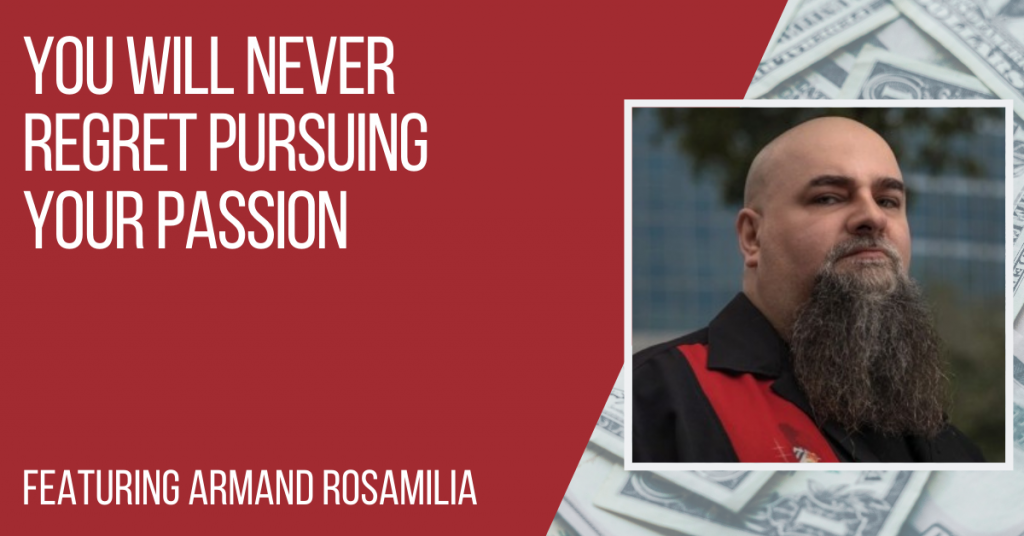
Ep296: Armand Rosamilia – You Will Never Regret Pursuing Your Passion
Listen on
Apple | Google | Stitcher | Spotify | Other
Guest profile
Armand Rosamilia is a New Jersey boy currently living in sunny Florida, where he writes when he’s not sleeping. He’s happily married to a woman who helps his career and is supportive, which is all he ever wanted in life.
He’s written over 150 stories that are currently available, including horror, zombies, contemporary fiction, thrillers, and more. His goal is to write a good story and not worry about genre labels.
He not only runs two successful podcasts but also owns the network they’re on, Project Entertainment Network.
His two podcasts are Arm Cast Podcast that interviews other authors, filmmakers, musicians, etc., and The Mando Method Podcast, with co-host Chuck Buda. The podcast talks about writing and publishing.
You can find him at Armand Rosamilia for his latest releases and interviews and guest posts with other authors he likes.
“When I look back on my life, at least I can say I tried, and it failed. I gave it a shot.”
Armand Rosamilia
Worst investment ever
Armand wanted to become a writer ever since he was 12 years old. However, he was now in his 40s and was yet to muster the courage to do what he wanted to do most—write.
Living a life of obligation
Everything that Armand did in his life was out of obligation. He got a job to be able to pay bills and take care of his family. He hated his job so much, but he couldn’t stop working. His ex-wife would not let him quit. Armand had to continue meeting his obligation to his wife and kids.
Sneaking out to pursue his passion
The dream of becoming a writer never left Armand. Every night he would sneak out of bed and stay up to write. This habit annoyed his ex-wife so much, but he kept doing it.
Hitting rock bottom and rising to his dream
One day, Armand found himself jobless, and even though his ex-wife was pushing him to get another job, he spent the time writing. He managed to finish his first story. He could not be happier even though he was dead broke. At this point, Armand’s ex-wife was tired of pushing him to get a job and decided to leave him.
Armand was devastated. His life was a complete mess, and he could barely take care of his family. He was ready to take on any job to make ends meet. However, Armand’s day of becoming a writer had come.
The breakthrough
Unbeknownst to Armand, a publisher had picked up his book, read it, and loved it. As his wife walked out of the door and left him for good, his phone rang. It was the publisher. He said he would love to have a conversation with him about a deal he had struck with a movie company in Hollywood. The company wanted to turn Armand’s book into a movie. This opportunity catapulted Armand’s career as a full-time author. He has not looked back since.
Lessons learned
Your dreams are valid even if other people do not believe in them
Do not stop chasing your dreams just because other people do not believe in them. You are the only one who can make your dreams come true. Do not let anyone tell you that you are not worth dreaming.
Andrew’s takeaways
Pursuing your dreams will not be easy, but you have to do it
If you have a passion, go for it. The world is not just going to open up for you. You have to do it yourself. People are going to resist and doubt you. They are going to challenge you and even discourage you. But, there is a point in your life when you have to decide to make your passion work. If you do that, hopefully, if you are good at it, then you will get your breakthrough.
Your dreams will not always be validated, and that is ok
It feels nice to be validated but don’t chase your dreams because you want validation from other people. External validation is not a guarantee. Pursue your dreams for yourself.
Actionable advice
Pursue your dreams. Strive for what you believe in and remain realistic about it. It is a lot of work, but you have to do it.
No. 1 goal for the next 12 months
Armand’s number one goal for the next 12 months is to continue working and learning.
Andrew Stotz 00:03
Turn on my radio voice. Hello fellow risk takers and welcome to my worst investment ever, stories of loss to keep you winning in our community. We know that to win an investing you must take risk but to win big, you've got to reduce it. This episode is sponsored by a Stotz Academy, which offers online courses that help investors, aspiring professionals, business leaders and even beginners to improve the finances of their lives and their businesses. Go to my worst investment ever.com right now to claim your discount on the course that excites you. The most fellow risk takers This is your worst podcast host Andrew Stotz. And I'm here with featured guests. Armand Rosa millia. Armand, are you ready to rock?
00:46
I'm ready.
Andrew Stotz 00:48
All right. Well, Armand is a new jersey boy, currently living in sunny Florida, quite a difference there, where he writes, when he's not sleeping. He's happily married to a woman who helps his career and is supportive, which is all he ever wanted in life. He's written over 150 stories that are currently available, including horror stories, zombie stories, contemporary fiction, thrillers, and much more. His goal is to write a good story and not worry about the genre labels. He not only runs to successful podcast, but he owns the darn networks that they're on. That network is called Project Entertainment Network. The podcast is the arm cast podcast, interviewing fellow authors, as well as filmmakers, musicians, and others. The Mondo method podcast is the other one, which he co hosts with Chuck Buddha, talking about writing and publishing, you can find him at Armando Rose millea.com. And for not only his latest releases, but also interviews and guest posts and other things that he does with authors that he likes. So also have the show notes, everything in the show notes so you can learn more about him. So Armand, take a moment and fill in for the tidbits about your life.
Armand Rosamilia 02:10
You know, I mean, you covered a lot right there. So I've been a full time author about a thing going on my ninth year now. And I've been wanted to be an author since I was 12 years old. So it's took me a little while but, but I'm finally living the dream.
Andrew Stotz 02:29
And I'm just curious about I love telling a story about this whenever I meet authors, and really, I call you a writer, I don't really call you an author. The reason why I do that is because I go back to the story of a friend of mine, and he and I took a vacation together to a like a detox resort in Thailand. And one morning, I knocked on his door, and we were going to have coffee together. He said, Come on in and, and I saw him and he was on his bed. I'm like, What are you doing? And he says, I'm writing. It's like, What are you writing, I don't know, just write and stuff, my journal and you know, just, you know, write ideas down, how long you've been doing it about an hour, you know, just here writing, as you do that often is pretty much every morning. And that was when it clicked to me that he is a writer, and I am an author. And the difference is, writing is a very tough experience. For me. It's hard, I got to rewrite, it's just so it's painful, but I can come up with a result. And he's published many books, and I've published, you know, a few books also. But that's when I kind of realized the difference. Someone and I curious, are you a writer? Are you an author?
Armand Rosamilia 03:43
You know, it's a great question, because it really depends on for me where I am with an idea or where I am with the story or, and all that there. There are days like that, where I will just write, I would just sit down and play with an idea. But then there are other times when I'm the author where I'm you know, it's a contract, I'm working on a book, I have the idea and I'm putting it together, and I'm fashioning that story into what it will become. So there's, there's many different, you know, there's there's ways I mean, you could label it any way you want. And for me, it's part of the process, I think, being the difference between being an author and being a writer.
Andrew Stotz 04:27
And I'm curious, like, how do you write do you write by outlining or you write by kind of, like, just free the free association? And also I'm curious, how do you revise like after you've written something? Is it like good on the first draft? Or do you need to go back and revise? I asked these for a friend of mine who always struggles with writing. No asking for me, obviously.
Armand Rosamilia 04:53
I am a pantser. I write from the seat of my pants. There's no outline Ah, just You know, being creative and just sitting down and just coming up with the next line, the next sentence, the next idea, the next beat of the story. And I, you know, that's how I write. And I'm very lucky because you know, 30 years of writing, I write a pretty clean first draft. So it's usually typos and stuff. So the idea I put down is usually that's the story, that's the book, I'll give it to beta readers. And they'll go through and find a couple things. Now there might be like, maybe a continuing error or something minor, but I have writer friends who will literally write an entire book, and then scrap it and write it again. And I mean, that would, that would drive me nuts. So, you know, it's the editor, my editor will come back and go through depending on if I'm self publishing, if I'm working with the publisher. But the process is pretty much, you know, me just sitting down and I'll write multiple projects a day. So on my board behind me, I have 17 different open projects right now short stories, novels, novellas, flash fiction, that are most of them are already promised to publishers. So I'm, you know, whatever is coming up next, I mean, I'll write three or four times a day, I'll do sprints, and it might be three or four different projects, or, as we're talking now, we're right in the middle of NaNoWriMo, which is a national Writing Month. So every November, the goal is to write 50,000 words in 30 days. And I do it every year. I've done it for about 12 years now. And I usually I finished this book, and at some point down the line, this book will hopefully be published somewhere.
Andrew Stotz 06:46
That's really inspirational. And I know for many of the listeners out there that want to write, you know, it's great to hear. Just curious, you mentioned something I'd never heard before beta readers, what's that?
Armand Rosamilia 06:58
So it's basically it's your, it's your front line of readers. It's the people who basically, once you're done, I'm done with my first draft, and I'm giving it to three or four people. And it depends on the book, I've, I'm lucky enough to build up a list of people. So if I'm writing, say, I'm writing a horror book, I know three or four people I will give that book to and, and I know some of them are, you know, if I'm writing military, I know a guy who I can send to and he'll tell me, this gun doesn't do this, or there's there's no, you know, you know, there's no, anything you're writing doesn't make sense, or it does make sense. Hmm. And so it's readers that have specific skills to help you put that book together. So that's, that's pretty much what it what a beta reader is. And it's different from an editor. Yeah, they're not they're not going deep into most of it is they're catching obvious spelling errors or common mistakes, typos. But their main idea is, does the story Make sense? Are the things in it making sense? Did I kill someone? Or did I do say she wearing pants in this scene, and she's not wearing pants for the next one. Like, you know, those those things that probably on my first pass writing through it, I'm not, you know, I missed or I screwed it up. I once wrote a book. And about seven or eight chapters later, I had this brilliant scene with this Russian Hitman, who I had, unfortunately, killed several chapters before. So I had to like that was like a major like, oh, let me let me rewrite this because that guy did not come. It wasn't a horror book where he came back from the dead. So
Andrew Stotz 08:44
now, well, that I really appreciate you taking a moment to share a little bit about your your experience with that, because I know, for all of us we have to write, we want to write, sometimes we don't want to write but this gives us some some good, some good little tidbits. So now it's time to share your worst investment ever. And since no one ever goes into their worst investment thinking it will be. Tell us a bit about tell us a bit about the circumstances and that leading up to it and then tell us your story.
Armand Rosamilia 09:12
So it has to obviously do with me becoming a full time author. And I was in a you're going back almost 10 years now. I was in a relationship with a woman. I was a full time retail manager working for a company that I hated. I mean, I hated reach, I worked my whole life. And I was just miserable. And her dream was Let's get married and you're gonna have a white picket fence and, you know, you know, the really the whole that whole American dream that I didn't really believe in, I want it I'm creative. I wanted to be a writer. And there were nights when I would sneak out of bed. It's her right and in she would get mad and she would call it my mistress. And for me, it was fun. It was almost like, you know, what's wrong with me like normal guys sneak out of bed and go on the computer, they're looking at porn or something or the football scores. I'm, I'm, I'm trying to write a short story
10:14
that she found that,
Armand Rosamilia 10:16
no, she did not. So it was like sneaking around. And I, it really beat me down mentally because I thought, I'm wasting my time I thought I felt guilty I should be dealing with my kids, I should be dealing with her I should be more present more in the moment. there instead of always thinking about the story as a, as an author, we're always right. You know, we go to Walmart, we go anywhere we go out to dinner, I'm eavesdropping conversations. And those conversations might appear in a story at some point, I'm watching characters, mannerisms, you know, all of that. And it drove her nuts. So I think the the, the kind of the rock bottom for me at the time, I thought it was I had lost my job. They wanted to move me to another store further away less money. And I basically looked at another company and tried to go there. And they matched the money. But then they fired me afterwards, which was awful. And I was really down. And she was she instead of being supportive, she was like, well go get another job. I don't care if you I don't care if you're a Walmart greeter, just you have to work and I said, but I, you know, I'm I was making good money. But I was working 8090 hours a week, you know, six days a week, seven days a week. So in the meantime, I said, You know what, I'll look for a job. That's fine. I will seriously look and I will do a lot of interviews and stuff. I'm getting unemployment right now, which is not nearly what I was making. But I also want to write I want to be able to write and so I started writing more and I'd always written but I kind of get serious. And the good part with it was this was right in the beginning with Amazon with ebooks. This is when it had all Kindle had all just started. So I wrote a I wrote my first zombie book. And it took off, it sold a lot. And I was making decent money not anywhere near a salary. But I was making good money. And I was we were fighting so much. I was sleeping on the couch. And it was me and my son was still living being and her and her son, and the house we were renting the landlord shut the water off. He wanted us to leave, he wanted his house back. And so we're trying to write books, I'm trying to look for a job. I'm broke. My son is just about to go for his first year in high school. At that time, she's leaving. And she's taking all the furnitures she's taking everything with her. And I have no water in the house. And it was like it was that. So frustrating. It was like, What am I doing? And and I really thought at that point, just go get a job, just go do something if it's a Walmart greeter, whatever, and not even to save a relationship, because that had been dead for a long time. But I think for my own peace of mind, but then it was that in the back of my head saying, you know what, if I don't do this, at this point, I'm in my 40s. If I don't do it, now, I never gonna do this. I've been wanting to be a writer since I was literally 12 years old. And I read my first Dean Koons book. And I've been wanting to do this, and it's now it's, you know, all these 30 years later, and I'm still not doing what I really want. I want to do, not what I'm supposed to do. But what I want to do. And it's funny, because because of the first the zombie book dying days, a publisher, unbeknownst to me, had picked it up and read it and loved it. And they had struck a deal with a movie company in Hollywood, one of these really small little beam movie. And so they sent me an email and said, Hey, we'd love to have a conversation with you. And so I I picked up the phone I talked to them. It was literally like a movie. So picture. We have no running water in the house. Okay, but we have a swimming pool that has been the motors broken. So it's green, there's frogs in it, it's disgusting. We have to take basically a bowl, fill it up from the pool, to pour into the toilets. So we can basically we can go to the bathroom and my son. And literally as she's walking out the door for the last time, the phone rings. And they say to me, we want you to write us we want you to write a serialized book for us because we're going to make it into we're basically Making it into a movie.
Andrew Stotz 15:01
And I right there. I'm in tears. You know, I mean, like, yeah, I'm really choked up just thinking of that. The visualization of that. I mean, I have that feeling of, you know, desperation or frustration, and you know, and then I have a call like that. Wow.
Armand Rosamilia 15:19
I mean, literally, she's walking out the door. And then they call me and they, and they, yeah. And it's like, oh, by and they so there's, they're saying, Oh, can you write this? And now at that point, if they had said, I want you to write a, I need you to write a romance, and we need it in Mandarin, I would have went, yeah, I can do that. It didn't matter. I was, I was all in. And the funny part was, so I'm selling myself, I could do that. Yeah, no, I do this for a living. I'm a full time author, which I I was because I didn't have a job at the time. And I'll never forget my son as I'm talking. And I'm saying, Oh, yeah, I do for a living, I do really well. My son is walking past me with a bucket of green water to use the bathroom. And he looks at me and shakes his head. And he says, Yeah, you're doing a great job. Oh, it just, it just cracked me up because I like I needed that, you know. And then the rest of the meeting went well. And I ended up in what became Miami spy games, which was, I think, a 12 part thing. And they paid me a lot of money. I mean, they basically paid my bills for like, the next year with that. And it ultimately never made it to be a movie, which was such a tiny, tiny thing. You know, books actually end up doing, but it was really the validation, hey, somebody really likes me, and somebody's going to pay me 1000s of dollars to write for them. And I've ended up writing 14 different books for that company. Over the years, and most of them were not ever made into movies, I did some ghost writing for them, but it really kick started the career. And I look back now after 10 years, almost of writing full time, and I'm, you know, I wonder where I would be if I had just given and if I just went and started doing, you know, stock boy overnight or something, and, and gave up the dream. Ah,
Andrew Stotz 17:14
so I this will call this episode, how I went from carrying buckets of slime water to become a leading author. So tell me, what did you learn from this experience?
Armand Rosamilia 17:29
You know, I learned a lot about myself, I learned that I was a good writer, I learned that. I mean, at the time and looking back, I had a lot to learn from publishing and just the growth and everything. But I learned that I was better than i thought i guess for all those years, I had been, I've been with her for six years and beaten down. And I felt like writing and reading and doing anything that wasn't, you know, with her was a bad thing. And I think that was really kind of the moment where I said, You know what, this is my dream. This is my dream. And I knew, from that point on anybody I was going to be with was going to have to understand that you know, and that might be selfish, and that might be arrogant, but I knew this is what I want to do with my life. And I don't care if I make $1 a year or a million dollars a year, I'm going to be a writer, and this is what I'm going to do.
Andrew Stotz 18:29
Let me summarize some things that I take away from this, you know, it was almost two years ago that my sister came to see me in Thailand. And it was a very, it wasn't an easy trip for her for me. My mother's living here. So she came to see my mom and me. And you know, we get along very well. But what happened was that my sister, you know, what she said to me was get a job. You know, and the dreams of my business and this and that of what I wanted, you know, she's like, just get a job, you know. And it was such a crushing blow for me, and particularly coming from her who I respect a lot, you know, and and also, of course, there was the truth, you know, that the elements of truth to it. Now, you know, later I was talking to my mom about it, because you know, she was in the middle of all that. And my mom just said, Well, you know, how much does she really know about your business and what your goals are and all that? And I said, Yeah, that's a good point. And I used it as a moment to challenge myself to say, No, this is my dream. This is my passion. And I think that and I ended up being able to make it successful. But it wasn't easy, and there was hard, definitely hard parts to it. And what I would challenge for the listeners, you know, out there is, you know, you do have to make a decision. If you have a passion of what you want. The world isn't just going to open up for you. People are going to resist If we're going to doubt you, people are going to challenge you. And, and it may or may not work, you know, your idea of who you are, and what you want to do may or may not work. But I think that, you know, we can take inspiration from from Armaan story and the idea that there comes a point in time where you got to say, I'm going to make this work. And if you do that, hopefully, if you're good at it, then you will get that call, you will make that breakthrough. It may be huge and may be small, but look for that breakthrough. And the other other thing that I took away is the idea of validation. And, you know, we're taught that we're, you know, don't don't live your life to get external validation and all that, well, yeah, I understand that. But damn it, it really feels great. When somebody appreciates the work that we do, and it really feels bad, when somebody just doesn't really appreciate it, I think this is a story about that, don't be Don't feel bad. If you want that validation, and you want it and you're striving for that, you know, don't lose sight. That's not everything in the world. And for people that are just putting you down or whatever, you know, that doesn't help. And so I think another lesson that I learned from this is, you know, know, when you've got to walk away from certain situations in relationships, so I took a lot away from this is anything you'd add to that?
Armand Rosamilia 21:26
I mean, you know, for me, was like you said, I mean, I have an ego, we all have an ego, I want to succeed. But I think even if, I look back now, and right now I'm in that awful job, I can at least look back on my life and say, You know what, I tried this, I tried it, and it failed. I gave it, I gave it a shot. I never wanted to look back and go, Well, I wish I could have done that. You know, I wish I could have been a try to become an actual writer and an author and publish books. So for that, I mean, I'm for that I'm blessed. And then just to be able to, to be able to do this for a living, and to have a wife now who, from day one completely, you know, she's not creative. She's not a writer, but she understood, you have a dream, and I'm going to help you with that dream as much as possible. And really, that's like humans, it's in the Bible that you read at the top. I mean, that's the most important thing for me.
Andrew Stotz 22:27
Yeah, I mean, I was interested, because when I read that, you know, let's go back to that bio. Ladies and gentlemen, let's listen. It's what he sent me was, he's happily married to a woman who helps his career and is supportive, which is all he ever wanted in life. And, you know, that's beautiful. And, and now I see the value of that statement. And when I first read it, I didn't, you know, understand the value of it. But now I see that really clearly. So, now, based upon what you learn from this story, and what you continue to learn, what one action would you recommend our listeners take to avoid suffering the same fate?
Armand Rosamilia 23:03
No, you, you go for your dreams, you strive for what you believe in, you're realistic about it, I got very lucky. I mean, I, I got very lucky, I had a little, slightly different path than other authors. But I also put in the work I also, you know, I my first story, published in 1988. So you're talking now it's, you know, 28, not 2009 2010. And I'm finally able to write full time. So it's a lot of work, but you have to do it. I believe if you're really passionate about something, you have to do it and the fact that it took me all these years to get here. It just makes it sweeter. It makes better. And there's so much more I can do. There's so much more that I'm going to do. And I think as long as you're doing that and you're shedding the negative around you the people that don't understand the people that don't get it. And that might not mean completely getting rid of them of You're out of your life, but kind of compartmentalizing them and saying, okay, that's their belief, and it has no bearing on what I believe. Because this is my dream, no matter what your dream is, this is my dream. And I think no matter what happens, you know, you just have to do that because you don't want to get 80 years old, 90 years old and regret the things that you never did I mean that it that makes some great that makes great movie scenes it makes great literature of the things uh, you know, mom gave up a singing career or ballet for her children you know, you you see all those cliche scenes and stuff in it but you don't want that in your life. You don't want to ever look back and I think that's for me that's, that's the one thing that's the most important no matter what happens. I gave it my all and you know Give it a shot. And so far so good.
Andrew Stotz 25:02
Right? All right. Last question, what's your number one goal for the next 12 months.
Armand Rosamilia 25:08
My number one goal is to just continue to, to work and to continue to learn. This is such a tough business, to, you know, to understand any changes constantly. I mean, in the next 12 months, Amazon is going to change three or four times the way they do things. Publishing is going game went through a huge upheaval with COVID, and everything. So there's so much to learn. So for me, trying to stay ahead of the technology trying to stay ahead of where are the new challenges, and where are the new places for me to sell books, when you don't have all the conventions in the book signings that I've had the last few years, and I've done, I've done really well with so for me, it's just kind of, you know, growing as a writer, and as a person, because I don't like that I'm going to be 51 I'm like an old man who doesn't want to do anything different. I want to just sit down and write and if you can't do that, in today's day and age,
Andrew Stotz 26:10
alright listeners, there you have it another story of laws to keep you winning, remember to go to my worst investment ever.com to claim your discount on the course that excites you the most. As we conclude, Armand, I want to thank you again for coming on the show. And on behalf of a Stotz Academy, I hereby award you alumni status returning your worst investment ever. India best teaching moment? Do you have any parting words for the audience,
Armand Rosamilia 26:37
I just want to really thanks for the opportunity. And this is a lot of fun. And, and that was a story, I don't get to tell all that often. And it brings back a lot of it brings back a lot of pain. But it also, you know, just sitting here looking back, I'm like, you know, what I really grew from I really grew from that. And I'm, I'm, that's the reason I'm here where I am right now. So I appreciate you having me on.
Andrew Stotz 27:02
I appreciate your vulnerability. And I think that from the perspective of this show, and what the listeners get from the show, it is really the opportunity for us to look back and be vulnerable. And look at what's happened in our lives and look at it objectively. And I believe that that's also why I say you are an alumni status now because you are someone that has shown the audience that you really can be sincere and vulnerable. And that's valuable. So that's a wrap on another great story to help us create, grow and most importantly protect our well fellow risk takers. This is your worst podcast host Andrew Stotz saying I'll see you on the upside.
Connect with Armand Rosamilia
Andrew’s books
- How to Start Building Your Wealth Investing in the Stock Market
- My Worst Investment Ever
- 9 Valuation Mistakes and How to Avoid Them
- Transform Your Business with Dr.Deming’s 14 Points
Andrew’s online programs
- Valuation Master Class
- How to Start Building Your Wealth Investing in the Stock Market
- Finance Made Ridiculously Simple
- Become a Great Presenter and Increase Your Influence
- Transform Your Business with Dr. Deming’s 14 Points
Connect with Andrew Stotz:

About the show & host, Andrew Stotz
Welcome to My Worst Investment Ever podcast hosted by Your Worst Podcast Host, Andrew Stotz, where you will hear stories of loss to keep you winning. In our community, we know that to win in investing you must take the risk, but to win big, you’ve got to reduce it.
Your Worst Podcast Host, Andrew Stotz, Ph.D., CFA, is also the CEO of A. Stotz Investment Research and A. Stotz Academy, which helps people create, grow, measure, and protect their wealth.