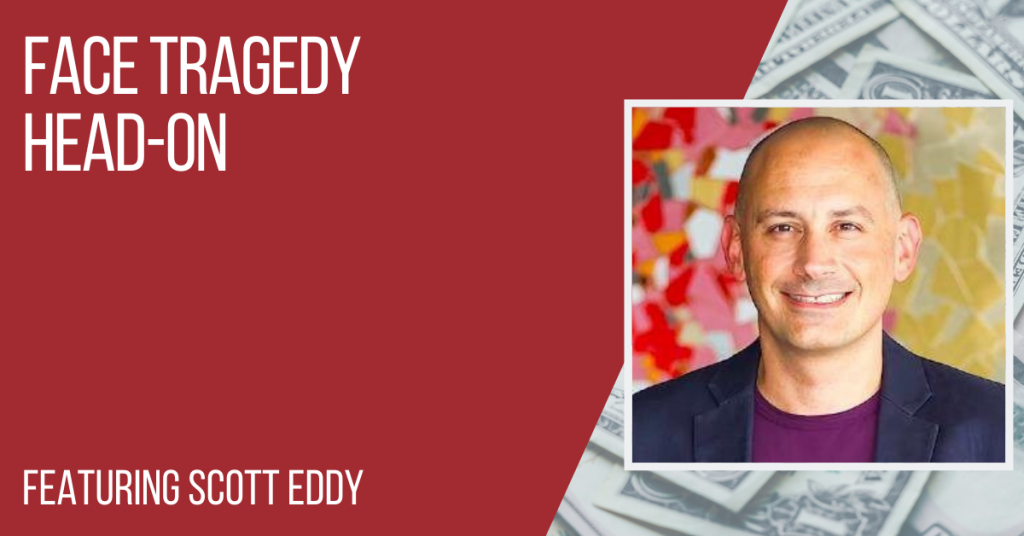
Ep291: Scott Eddy – Face Tragedy Head-on
Listen on
Apple | Google | Stitcher | Spotify | Other
Guest profile
After 10 years in investment banking, Scott Eddy moved overseas and lived in Europe and Asia for 17 years. While living in Bangkok, he started the first digital agency in Southeast Asia, and it remained the biggest in the region for five years.
After selling the agency and spending some time in Europe while building his personal brand, he now travels full-time while building social media strategies, speaking at conferences, creating video marketing packages, and consulting for the world of luxury travel. He is also the TV host for the new travel series on Lifetime Television called Video Globetrotter.
“The one skill that you need no matter what industry you’re in is sales.”
Scott Eddy
Worst investment ever
Scott comes from a police background. His father was a Fort Lauderdale cop. Just like everybody on his dad’s side, Scott’s plan in life was to graduate high school, join the police academy, become a cop, get married, have kids, retire, and die.
Getting ready to be a cop
Scott spent every day after school in the police department, where he learned everything about being a cop. He watched an autopsy when he was 13, saw interrogations, and went on ride alongs. That was Scott’s whole life.
The dream turns to dust
Three weeks before Scott graduated high school, and just a few months before he joined the police, his father was killed in a plane crash in the line of duty. This turned Scott’s whole world upside down and killed his dream to become a police officer.
Lessons learned
Face tragedy head-on
When tragedy strikes, you could stick your head in the sand, pity yourself, allow yourself to get crushed every time you think about it, and prevent you from moving forward. Or you could stare it in the face and move on with your life.
Choose your friends wisely
Continually reevaluate and look at who you surround yourself with. If it’s the wrong people block them, unfollow them and just immediately cut them out of your life. Always have people that uplift you. It doesn’t matter what industry you’re in.
Manage your time well
Time management is your best friend or your worst enemy. You have to be religiously strict with your time.
Andrew’s takeaways
Put your life into perspective
One of the tools to put your life into perspective is to look at it from the outside in. Talk to people and get other views. Use this tool to move through tragedy.
Tragedies are not always mistakes
Sometimes a tragedy can be a mistake; sometimes, it’s just a simple tragedy. How we handle the bad things that come into our life is what matters. Take tragedies head-on and allow yourself to grow from that experience.
Actionable advice
Before you make any big decision, take a step back, take an extra day, and look at it from the outside looking in. If you have people you trust in your inner circle, ask for their opinion. By looking at things from the outside in, you’re always going to have a clearer mind.
No. 1 goal for the next 12 months
Scott’s goal is to make his personal brand continue to grow.
Parting words
“Stay positive, go big, or go home.”
Scott Eddy
Andrew Stotz 00:02
Hello fellow risk takers and welcome to my worst investment ever stories of loss to keep you winning. In our community. We know that winning investing you must take risk but to win big, you've got to reduce it. This episode is sponsored by a Stotz Academy, which offers online courses that help investors, aspiring professionals, business leaders, and even beginners to improve the finances of their lives and their businesses. Go to my worst investment ever.com right now to claim your discount on the course that excites you the most fellow risk takers, this is your worst podcast host Andrew Stotz, and I'm here with featured guests Scott, Eddie Scott, are you ready to rock?
00:46
I'm ready.
Andrew Stotz 00:48
Let me introduce you to the audience. After 10 years in investment banking, Scott moved overseas and lived in Europe in Asia for 17 years. While living in beautiful Bangkok he started the first digital agency in Southeast Asia, and he remained the biggest one in the region for five years. After selling the agency and spending some time in Europe while building his personal brand. He now travels full time while building social media strategies, speaking at conferences, creating video marketing packages and consulting for the world of luxury travel. He's also the TV hosts for the new travel series on Lifetime Television called the video globetrotter. And I first found Scott years ago on Twitter. Right now he's got more than 600,000 followers on Twitter. And I'm so happy to be able to bring you to the audience. Scott, take a minute and filling further tidbits about your life.
01:51
Part, you cut out for a second, what was that
Andrew Stotz 01:53
billion? Any further tidbits about your life?
01:57
Yeah, so,
01:58
you know, you
01:59
pretty much covered it. Um, you know, I grew up in South Florida. And I went into investment banking training program right after high school. And I didn't, I went in there and advice of a friend. And I didn't know anything about selling about finance, I was bad at math, it was all arrows were pointed the wrong direction. But I did it anyway. And it was the best decision I ever made. Because I learned that one skill that you need, no matter what industry you're in, and that's sales. And obviously, being a stockbroker, especially in the late 80s, early 90s. You know, it was a very aggressive sale, lots of cold calling. And in my opinion, that's the best way to learn sales. So I did it for 10 years. And then they sold the firm all of a sudden, and my friend's friend was an expat living in Bangkok. And he says, Listen, you're 29 you've never been to Europe, you've never been to Asia. What's wrong with you hop on a plane and come over. So I bought a two week ticket. And after four days, and Andrew, you'll attest to this. After four days, I completely was in love with Thailand, Southeast Asia, the warmness of the people. I just completely fell in love with the culture. And I called my mom, I said, I'm never coming home, send all my stuff. And I lived in Bangkok for 11 years. You know, for me, it was happening.
Andrew Stotz 03:34
Yeah. And I know that feeling because I know when I first came in 1989 it was just a booming place. I think for a lot of young people, they asked, asked us, you know, why do you come at that time, and they don't realize that Thailand was one of the fastest growing economies in the world. And so slowly, it was, it was just booming. So it's so exciting. But I think the other part that you mentioned is like the warmth of the people is what really fantastic.
04:03
And that rubs off on you. It's fantastic. It really is.
Andrew Stotz 04:07
Yeah, I would say that. When I go back to the US, I've been back to us in about four years. But when I go back to the US, it's so harsh. People are so strong and confident and rude sometimes and just and loud, and all those things that I never noticed when I you know was living there. But when you step out and then you're socialized I've lived now longer in Thailand than I lived in the US. So I have this, you know, a level of socialization that happens here. And then you go back and you realize what have I become, but I used to be that but now I become this and yeah, it does really rub off on you and I'm sure even in your life now. There's so much that probably, you know is influenced by that such as one of the things in Thailand that I tell my American friends is that you really can't get angry. It just doesn't work here. It, it can end in death. Yeah, but the point is, is that it? Thailand kind of smoothes your rough edges.
05:18
Yeah, yeah, I notice it. You know, typically in a non pandemic year, I normally in a different country have a week and I do 2025 countries a year. But I always do round trips from South Florida, I never do back to back trips. So every time I come back here, it's I get that same feeling that, you know, I just think that my belief is like this. I think that everybody, once they finish high school, they should spend six months in a developing country, not first world, not one day, not Singapore, not I'll show you, a developing country, and then come back to the US. And I think your whole life will be different. I think it should be mandatory. Yeah. Because it changed my life. And I was 29 I can only imagine what would have happened if I came when I was 18.
Andrew Stotz 06:16
Yeah. So true. So true. And let me ask you to explain your your business model a little bit thinking about young people out there listening to this show that thinking, wow, I want to do what you're doing or you know, what, how would I, you know, try to become I don't even know if you'd call it an influencer. But somebody that really is known and can build a business around it. What tell us just a bit about how your business works. And then what advice you'd give to young personalities in relation to that.
06:50
Yeah.
06:50
So you
06:51
know, when I started the agency, social media started simultaneously at the same time, and I sort of built a huge audience. But the reason I built a huge audience was not because like, I didn't even know the word influencer wasn't even at work. Um, I didn't know what I was building. I just, I'm really addicted to meeting new people all the time. So for me, my version of social media, when I was growing up, was to go out all the time, go out in the evenings and go to events and go to parties. And I grew up in South Florida. So going to South Beach was big, big for us. And when I got to Bangkok, I went out and socialize all the time, when social media came around, it was like, I saw a way that I could socialize 24 hours a day, globally, and make friends all over the place. So for me, that was like, wow, I could do what I do in real life. But like virtually, this is like, amazing. So you know that when Twitter first came out, every x time in the world was on there, because that's how you got your news. That's how you talk to other expats. And that's how, you know, that's how the world went in the beginning. So Twitter was booming, in the beginning, especially in Asia. So I really rode that wave and built up a huge audience. And then it just all steamrolled from there, you know, any new platform that opened up Facebook, Instagram, whatever, it just all, you know, the spillover effect. And the audience, you know, followed. So you gained a big audience, okay? Now, today, the world is very noisy, even though social media is still in its infancy stage. I mean, 12 years, 14 years, 1213 years, it's not a long time for our industry. So it's still in its infancy stage, even though some people think it's mature. It's a very noisy place. You know, now you're fighting against algorithms, you're fighting against building an audience, everybody wants to do the same thing. You know, today, you have to be very unique, you have to be very strategic, you have to be very niche, you know, double down in your niche, you can't be general, you know, how many food bloggers can Instagram take? How many travel influencers can insert Instagram take, you know, it's, it's got to get very narrow. Um, you know, what I see a lot of people do today and, and in my opinion, and again, there's exceptions to every rule. But in my opinion, I think that building a huge audience on one platform, if that platform ever changes, you're screwed. Like I see all these people, I know somebody who has a million followers on Instagram, they don't have a website. They're not on Facebook, they're on Twitter. They're not on tik tok. They're not on LinkedIn, just Instagram. I mean, that's that's a fairly risky
Andrew Stotz 10:00
When you say, in fact, that used to be the advice, you know, focus on one, and build off,
10:08
but you exactly got to be everywhere. Because what happens if Mark Zuckerberg changes everything with Instagram tomorrow? That what? Yep. You know, it's just it's very risky. So, you know, if I had to do it all over again, um, I would not build my brand the same way that I did. So now, let me just tell you where I am today. Now I have a huge audience. And overall, the platform's I have about a million followers and I my reach is somewhere around seven, 8 million eyeballs a month. But what I do is, I do a lot of influencer type campaigns. But number one, I'm getting paid a day rate when I do these trips, but I always negotiate and build my itinerary where I'm sitting down and having drinks or meeting with decision makers. If I'm going to a hotel, I'm making sure I need the director of PR the gn, the Director of Marketing, if I'm going to a destination, I make sure and meet the managing director of the Tourism Board, whoever the decision maker is because I do so much more provide so many more services than just my audience. My audience is what gets exposure. But I have I build on digital strategies, I do consulting, I speak at different events, I run very high level Facebook ad campaigns. Um, you know, there's, I provide all the services of a digital agency. But I just don't advertise it out from it. So I let the audience pull in the eyeballs. And then I take those eyeballs and convert them into long term clients, which has worked well until now.
Andrew Stotz 11:55
Yeah, I'm thinking about like the influencers that are sitting on the beach at a hotel taking a picture of themselves in Ragini. Right? It doesn't, it doesn't doesn't matter who the GM is this. But this connects with what you described yourself as a social person. So you're taking an advantage that you have in something you'd like to do the social aspect, and mixing it with that travel? Yeah, it's very fascinating. And that, so I'm getting two things from you. One is that I don't want to, I don't want it to sound bad, but it's kind of spread yourself thin. In, we always said don't spread yourself too thin. But you do need to spread out through the different social media. And of course, you may find that one is, you know, really suitable for you fine. But if you don't have an email capture, if you don't have a way of keeping the right audience, if they were to shut you down, then you've got nothing.
12:52
And there is there's one thing to stretch yourself thin, there's another thing not to be everywhere. You still need to have a presence.
Andrew Stotz 13:00
Yep. And then the second thing that I take away from that is the idea that nowadays particularly, you've got to be unique, as you said, they got plenty of food bloggers and cooks and this and that. So what is your angle? And that kind of goes to this podcast, because when I wanted to go, you know, make a podcast about finance, the most obvious thing to do is interview financial people about their financial success. Right? And there's a lot of shows doing that. And they're doing very well. And I thought to myself, you know, how am I going to compete in that space? So I decided just to wait and keep thinking about it. And it was about five, about three years ago, I sent out an email to, to my list of friends and, you know, colleagues as well as clients. And I asked them, would they be willing to share a story of their worst investment ever? And I received 500 written replies. Wow. And from those 500 written replies, I knew that this podcast has a place in the world where we can take the financial aspect, which is my area, but take the loss aspect, which is the guest area, and bring those two together into a story and into emotion. And by bringing all that together, you know, I've created a little niche in that niche. Sure, you know, it's fun. And that really brings us to the question, which is, now it's time to share your worst investment ever. And since no one ever goes into their worst investment thinking it will be. Tell us a bit about the circumstances leading up to and then tell us your story.
14:45
So
14:48
I'm going to share with you something that it's not necessarily an investment. But what I'm going to share with you is a tragedy Okay, Take for it what you will. When I was growing up, I was born in Michigan. My father's whole family is from there. My father was born there. And my dad was a Michigan State Police. We moved to Fort Lauderdale when I was three. My dad became a fort lauderdale cop. My middle school in high school every day after school I spent in the police department, because the my life's plan was graduated high school, join the police academy become a cop get married, have kids retire and die. Like that was the like claim because that's what everybody on my dad's side did. For me, um, I was I knew everything about being a cop. By the time I entered high school, I took my driver's license test and a police car. I watched an autopsy when I was 13. I saw interrogations, I went to ride alongs I mean, I knew everything I lived long in order in Chicago, PD and NCIS. Like That was my whole life. Three weeks before I graduated high school, and I had my police academy date was a few months away. Three weeks before I graduated high school, my father was killed in the line of duty in a plane crash. And it turned my whole world upside down. And needless to say, That's why I didn't become a police officer. So the worst thing that could have ever happened to me in my life has already happened. So what I do in my life, and I do this every single day, is anytime. something bad happens anytime an outside negativity bounces in my head, anytime. Anything on a downward spiral is going on around me. I always think the worst thing that could ever happen to me in my life has already happened. Now, there's zero downside. And that always bounces me back up. So for me, the worst thing that ever happened to me my worst investment, if you will call it has already happened. And that's how I deal with it psychologically. And that's how I deal with it every single day moving forward.
Andrew Stotz 17:24
And as you look back on this, you know, situation, the story that you've talked about, and the way you've handled it, what lessons did you learn from this, you know, tragedy.
17:37
I have one sister, um, and she handled it one way, she still has a very hard time getting on planes, you know, takes her three values and just walk on the plank, so to speak. And, you know, she she nervous on plane, she can't even talk about it, she doesn't bring up my father's name, you know, like nothing. Or there's me, I want to fly as much as I can. I want to face that fear of flying. Um, you know, I've even thought about taking private, but you know, being a pilot, like kicking lessons flying a plane, you know, I want to really, like punch it in the nose. So there's two ways you can handle things like this, you could stick your head in the sand, and just say, Oh, woe is me. And that's gonna be it. And you're just crushed every time you think about it, and it affects you moving forward. Or you could stare it in the face and say, Listen, I had a tremendous childhood. And I have memories that will last me a lifetime. And I'm going to make you proud every day.
Andrew Stotz 18:48
That's it. Yep. And, I mean, I lost my father about four, four years ago. And he was 82 at the time. And in the moment, he made it. Yeah. in the morning. We were on the golf course, in the, you know, in the late morning, we were having coffee at Starbucks. We had lunch together. And then I went home last night, he sat down in his chair, and I went to take care of my mom who was at the rehabilitation for his stroke. And when I came home, he had a massive hemorrhage. And within about 1212 or 14 days, he was he's gone. And I realized, you know that I had everything of him that I couldn't ask for more. He was a great father. I had him all my life. He was a great husband for 59 years. And it was sad and tragic. It was not something that I felt was unfair, or you know, I felt that tragedy, but I can only imagine that you're at that age and already talking about the way you wanted to be a cop must have Then how you looked up to him as we often do our fathers. But what's interesting is how you decided to use that experience. Because as you're telling us about it, I'm thinking about, aha, interesting because you've built your reputation and your life around flying, that you are not a guy that sits in an office in one place now. So I think what I take away from your story, is the idea that our tragedies are mistakes. You know, sometimes it's a mistake, sometimes it's just a simple tragedy, but the bad things that come into our life, if we can take them head on, it's going to allow us to grow from that experience.
20:45
100%
Andrew Stotz 20:46
Yeah, it's a great, great lesson. And I think that for the listeners out there, who haven't had tragedy in your life, be grateful for this day that you've gotten to this point without that tragedy, but know that it will come. And when it comes, I think Scott's given us some good perspective on you can, you know put your head in the sand or you can say, I'm not going to talk about that? Or you can face it, and take it on? So based upon what you learn from this story, and what you continue to learn in your life, what action would you recommend our listeners take when they are faced with this same type of tragedy?
21:32
You know, hello,
Andrew Stotz 24:59
that's the beauty of not being live. I just kept recording. And all we got to do is continue where we were.
25:06
Yeah. So what is the lighting? I said, so
Andrew Stotz 25:08
the last thing, the last thing is I asked you the question. So let me just ask that. And we'll start from this point. Okay, based on what you learned from this story and what you continue to learn, what one action would you recommend our listeners take when they face tragedy? Like you face?
25:24
Listen, seriously, I would say, before you make any big decision, you're typically going to make that in a very emotional state, take a step back, take an extra day, look at it from the outside looking in. If you have people you trust in your inner circle that has a level head, ask their opinion, because looking from the outside in, you're always going to have a clearer head. Most of the time people make bad decisions based on what they want short term. And every decision I make I look at the 510 year results. What am I gonna? How is this gonna benefit me in a year in five years in 10 years? Not? how's this gonna benefit me next week? You understand? Yep. So,
26:19
perspective.
26:21
Yeah, and that's not always easy. And that's why everybody isn't successful.
Andrew Stotz 26:27
So, for the listeners out there, when you face that tragedy, it's easy to get caught up in yourself, and in the moment and in the pain. But the lesson I take from this is, number one, put it in perspective. But one of the tools to put it in perspective, is to look at it as you said, from outside, in, talk to people get other perspectives, and use that as a tool to move through the tragedy. But then think about the next five to 10 years. And just it's great, great lesson, and we are all going to face our tragedies. So I love it. All right. Last question. What's your number one goal for the next 12 months?
27:14
You know, I get this question a lot. And it's always shocks people to say that I don't really have a goal. And the reason for that is this. And having gone through this whole pandemic thing this year, this is really proven that my thinking was correct. My goal is to always think like a startup. Always think like, I'm a little mom and pop shop, where there's one decision maker and I can make I can change things overnight. So my sole goal is to make my personal brand continue to grow. That is really the only thing that matters to me. Because if that happens, then opportunities will arise from it. Now, thinking like a startup means when a pandemic happens, and my whole life gets cancelled, every retainer time drops me, travel ends overnight. All my speaking opportunities dry up, literally lost over $350,000 in revenue since March. But I was able to pivot overnight, and generate new income streams and, and think about how I can, you know, refresh my brand and come out bigger and better and I'm relaunching the whole new Mr. Scott Eddy over the next couple of weeks, new website, new brand new services, new everything. Um, you know, it's just, it's, it's, it really allows you to stay on your toes and not be worried if I had big grand, huge goals. And then the pandemic came. Like, they're all gonna get annihilated. But if you just stay small, but look at the bigger picture, you always ready for everything.
Andrew Stotz 29:18
Yeah. And if you built yourself in a kind of multi dimensional way, rather than a one dimensional is another aspect that I hear from you, that allows you to make that transition. So that's great inspiration. All right, listeners, I'll
29:35
tell you one more thing. I'll tell you one more thing. The most important thing in my life is the people that I surround myself with, because I see so many people in my position and also in other industries, and they get torn down all the time, because they surround themselves with the wrong people. I constantly reevaluate and look at who I'm surrounding myself. With and if, if it's the wrong people, I will scoot them out, block them unfollow them, they will be cut out of my life immediately. Or you really talk to them once every six months instead of six times a day, whatever it is, but having a positive mindset on a daily basis is the most important thing. It doesn't matter what industry you're in.
Andrew Stotz 30:29
Yes, it's a great piece of advice. I, you know, I have, I was just about to close out the show. But I have one final question that come up in my mind. And that is, you know, let's imagine that you're not on social media, you're a typical person doing a typical job, you know, I mean, you're on social media for friendship, or whatever your family. And, you know, managing the relationships in your life is not too difficult. Managing the people in your life is not too difficult. But when you decide to go, you know, big on social media and other places, all of a sudden, you have magnified, multiplied, you know, that the interaction that you're having Sure. And it becomes it becomes difficult, because the one hour you used to be able to spend with each of your friends now is getting deteriorated instead, because you've got to take some of that time and devote it to the 600,000. You know, people that want to hear what you have to say, how do you manage that?
31:32
Time management is your best friend, or your worst enemy? Yep, you have to be religiously strict with your time. So I made a decision about seven years ago, I wake up at 5am every day, seven days a week. I start today, every day unless it's listed as a hurricane outside, by walking outside and going somewhere to watch the sunrise. While I'm doing that, I'm answering emails, I'm doing conference calls to Thailand and Singapore, Europe. I'm just working. But I'm happy. It's impossible to have a bad day if I start every day like this. And I am religious with my schedule. That's why when you first contacted me, I was so adamant about you permitted to Google and you know, I only have these times and this and that because I live and die by a calendar. Yep. And you have to, you know, too many people. They're like, Oh, yeah, but I need time to decompress. And I need this. And I need that and you didn't put it in your schedule and do it. But they just want to do it at their own free will. That's not the way life works. Not if you want to be
32:46
nice, you're building a big burden. Yep. If you want to be a little mom and pop for the rest of your life, it's fine.
32:52
But don't complain when somebody passes you by. And you'd be like, well, I've been doing it for just as long. Why are they getting this opportunity? Well, they put in the work. It's called sweat equity. I'm all about it, baby.
Andrew Stotz 33:08
Definitely. Well, we're feeling it. All right. Hey, listen, is there you having another story of loss to keep you winning? Remember to go to my worst investment ever.com to claim your discount on the course that excites you the most. And as we conclude, Scott, I want to thank you for coming on the show and on behalf of H dots Academy, I hereby award you alumni status for turning your worst experience ever into your best teaching moment. Do you have any parting words for the audience?
33:42
Stay positive, go big or go home.
Andrew Stotz 33:45
Amen. Well, that's a wrap on another great story to help us create, grow and protect our wealth and our health. Fellow risk takers. This is your worst podcast host Andrew Stotz saying. I'll see you on the upside.
Break down the barriers, silos, and hierarchies. Get out of the traditional mindsets that you have created, and instead ask yourself if you’re getting the results that you want.
Connect with Scott Eddy
Andrew’s books
- How to Start Building Your Wealth Investing in the Stock Market
- My Worst Investment Ever
- 9 Valuation Mistakes and How to Avoid Them
- Transform Your Business with Dr.Deming’s 14 Points
Andrew’s online programs
- Valuation Master Class
- How to Start Building Your Wealth Investing in the Stock Market
- Finance Made Ridiculously Simple
- Become a Great Presenter and Increase Your Influence
- Transform Your Business with Dr. Deming’s 14 Points
Connect with Andrew Stotz:
About the show & host, Andrew Stotz
Welcome to My Worst Investment Ever podcast hosted by Your Worst Podcast Host, Andrew Stotz, where you will hear stories of loss to keep you winning. In our community, we know that to win in investing you must take the risk, but to win big, you’ve got to reduce it.
Your Worst Podcast Host, Andrew Stotz, Ph.D., CFA, is also the CEO of A. Stotz Investment Research and A. Stotz Academy, which helps people create, grow, measure, and protect their wealth.