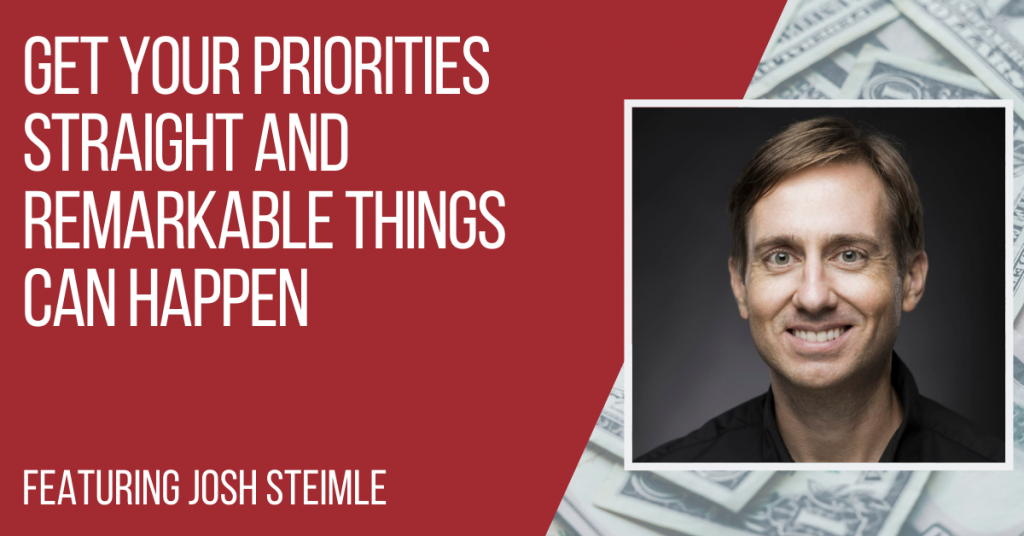
Ep272: Josh Steimle – Get Your Priorities Straight and Remarkable Things Can Happen
Listen on
Apple | Overcast | Stitcher | Spotify | Other
Guest profile
Josh Steimle is an entrepreneur, author, and speaker, best known for his framework The 7 Systems of Influence and the 300+ articles he’s published in more than two dozen publications like Time, Forbes, Fortune, Mashable, and TechCrunch. Get started on writing your book with Josh at Publishedauthor.com.
“Business should never be your highest priority. If it is, you will lose the business along with everything else.”
Josh Steimle
Worst investment ever
Wanting to be like the greats
Josh was a college student when he made his worst investment ever. At the time, he had what he thought was a great job making $13 an hour. The company Josh was working for was growing like crazy. And so he thought he should leave and start his own business.
Josh would look at the company executives flying around, meeting with venture capitalists, having all the fun and making all the money, and think to himself, “I could do that too.” So he quit his job and started his own business.
Doing what he knew best
Josh knew how to design websites and hence started a web design business. He thought this would be as easy as launching a business, and then people line up and hire him. But nobody lined up. Soon enough, Josh had no money to pay rent and sold everything he owned on eBay to pay the rent.
Things start to looking up
After a while, Josh got a few clients and was able to survive. The business continued to grow steadily. Then he brought on a partner and then another, and the company grew a little bit more. It was tough, but he made it along.
Heading separate ways
Josh and the partners kept fighting and disagreeing on how to run the business. Eventually, things got so bad that they had to sell the business.
Josh restarted over again in 2003. Things went back to being tough. Because of the bad experience he had with his partners, Josh decided to do this by himself.
Giving business his all
Josh went out and got a $100,000 loan from the bank. He also borrowed money from family and friends. He invested all the money in his new business, and for the next four years, he drowned himself in work.
Josh would work 100 hours a week. He would go to sleep at three am on his office floor, wake up at 6 am and go right back to work six days a week. Josh didn’t take holidays; he worked Christmases and birthdays. He missed weddings and family reunions. Josh thought he was investing in himself, the business, and his family’s future. He believed that everything was going to pay off eventually, someday.
Four years of nothing
For the next four years, Josh immersed himself in his business, but he made absolutely no profit. He didn’t pay himself a dime all this while because he couldn’t afford it and was drowning in about $500,000 of debt.
Josh’s family had gained nothing from all the time and energy he put into the business. He was now at risk of losing his wife and family if he kept going down this path. It took Josh four years to realize that this was not working; it was not a good investment, and that he was losing everything.
Taking it a notch down
Josh decided that he would not continue working like this anymore. He started working 40 hours a week, spent more time with his wife, and didn’t work weekends anymore.
A funny thing happened once Josh set those boundaries and said no more. Within two months, he was paying himself for the first time in four years. He was able to pay off 10 or 20 grand in debt every month, and his wife could quit her job. She had been supporting the family for the previous four years, and she hated it. Everything turned around as soon as Josh set those boundaries.
Lessons learned
Set your own boundaries
Don’t let life set the boundaries for you, do it yourself. If you leave it to fate, the boundaries that life gives you are much more painful than the limitations you can set for yourself.
Get your priorities straight
Prioritizing is very important. Your family and your health have to come before your business. If you don’t take care of your health first, you won’t be very good at work, you don’t think very clearly, and you’ll end up dying because you’re not taking care of yourself. If you put your business ahead of all your other priorities in life, you will lose the company along with everything else. So get your priorities straight.
Build a life outside of work
Having something outside of work allows you to focus, ironically, more on the work. When you’re in the business every day, all day, and that’s all that consumes you, you can’t see the forest for the trees, you can’t see the decisions or the choices. But when you step back, and then you come back in, you often see things more clearly
Andrew’s takeaways
Sometimes working harder produces less
Working harder during a crisis does not produce more income or more revenue because nothing is happening. Focus more on your wellbeing.
Small businesses are a trap
Be careful before investing in a small business. You know, you go into it with all these dreams, and you get down the road and get to a point where you can’t go back, and you can’t go forward.
Actionable advice
Every 90 days, take a break, take a day off and do nothing, no work, disconnect from the internet, disconnect from your phone, and do absolutely nothing. Go somewhere and spend time with your family or exercise or read a book, but not a business book.
Do something that’s completely disconnected from your work, your career, and your business. If you do that, you will come back to your career and your business with ideas that will push you ahead. This will save you time and money. It will help you see things more clearly.
No. 1 goal for the next 12 months
Josh’s goal for the next 12 months is to keep his priorities in life straight. He is continuing to figure out how to step back and make sure he does not get sucked back into crisis mode, where he feels like he has to work all the time.
Andrew Stotz 00:03
Hello fellow risk takers and welcome to my worst investment ever stories of loss to keep you winning. In our community we know that to win in investing you must take risk but to win big, you've got to reduce it. This episode is sponsored by a Stotz Academy which offers online courses to help investors better manage their stock portfolios. aspiring professionals to learn how to value any company in the world business leaders to make their companies financially world class and even beginners to implement a simple lifetime investment plan. Go to my worst investment.com to get free access to my short course six ways to lose your money and six strategies to win where I share the six lessons I've learned from all of these podcasts, interviews. Fellow risk takers, this is your worst podcast host Andrew Stotz and I'm here with featured guest, Josh stymy. Josh, are you ready to rock?
Josh Steimle 00:57
Ready, Andrew, thanks for having me on.
Andrew Stotz 00:59
Yes. And for the ladies and gentlemen out there listening. You know, it is very early morning. Josh has time. So he is an early bird. So let me tell the audience a bit about you. Josh Stein. Lee is an entrepreneur, author, speaker, best known for his framework, the seven systems of influence, and the 300 plus articles he's published in more than two dozen publications like time, Forbes, fortune, Mashable, and TechCrunch. Now I first came across Josh, at number 1588. What is 1588? That is the episode of Entrepreneur on Fire with John Lee Dumas. And so I was just going back and listening to that, and listening to some of your journey in China. But maybe you can take a little bit of a few moments to fill any further tidbits about your life.
Josh Steimle 01:52
Sure, well, I got started on my entrepreneurial journey in 1999, I started a marketing agency called m WI, you'll hear a little bit more about that in a moment. But that was a company that kind of failed its way forward to 2013. That's when I began writing for Forbes, which changed my life entirely opened a lot of doors. And now I've passed in Wi Fi on to my partners, they run that business, and I focus on helping entrepreneurs to become more influential. So I run a program called published author, I help entrepreneurs to publish a book and leverage that book to grow their businesses and make it more successful.
Andrew Stotz 02:31
Actually, I was going through your website, and seeing kind of what you're doing there. It looks pretty fascinating. You have different packages. But you know, why is it that somebody should be writing a book anyways?
Josh Steimle 02:45
Well, the book is like a business card on steroids. It gives you authority in a way that nothing else can quite I mean, you write a book, it's out there forever, it can benefit you for the next 20 years. And I saw this myself, when I wrote my first book, I published my first book in 2016. And immediately, I got paid more to speak at speaking events, and people took me more seriously. And we were able to land clients we couldn't land before. I mean, I would just walk into meetings, and I would hand people the book and say, Hey, here's my book as a gift. And all of a sudden, I saw people's eyes light up, and they look at me differently. And so I saw the authority that came from having this book, and I thought, Hey, this is something valuable here. So when I started to coach people on how to build their influence, and thought leadership, I thought, everybody really needs to have a book, this is really the core of building out your authority. And it's a great way to get your message out there and impact the world. So if you have something that you know, that you know, could help a lot of people, then a book is one of the most solid ways to get it out there.
Andrew Stotz 03:52
Um, that's fascinating. I know, I've written a few books. And I always say I'm an author, not a writer, you know, writing is a bit of a painful process for me, I guess it is at some point for everybody in the process of getting something published. But, you know, I've written a book on how to start building your wealth, which is one of my online classes, you know, how a beginner can invest? I've written a book on nine valuation mistakes and how to avoid them for my valuation masterclass. When I saw my students making the same mistakes over and over again, I thought, well, there's nine common mistakes here. That's the makings of a book. So I made some books like that. But I'm curious like, whether it's me or someone else, maybe you could just walk through, you know how you would do that? Because it just seems like it's a daunting task.
Josh Steimle 04:43
It is, it's tough to find out often what the book is that you're supposed to write and a lot of people will default to. Well, I guess I'll write a memoir or an autobiography about my life and my struggles and everything I've been through. This is kind of what we default to when we don't know what to write and That's generally a mistake, because most people aren't that interested in our lives, but they're interested in what we know and what how that knowledge can help them and change their lives. And so where I start people on when I work with them on figuring out what book to write is I go through these seven systems of influence. And the first step is figuring out Well, what do you want out of this? Why would you write a book? What do you want to do with this? What's the vision? What's the goal? And if the goal is, well, I want to grow my business. That's what I really want to write this book for us so that I can make more money. And yeah, I want to impact people as well. But primarily, the goal is to grow your business? Well, if that's the case, then the question is, what kind of book is going to attract your ideal audience and make them say, I want to work with this person, I want to go hire this business, or I want to hire this person, as a coach or consultant. And so we walked through the steps of, Okay, let's take that vision, let's figure out why you're the person to write a book about your topic, your expertise, who is your real ideal audience that you want to reach out to, and then we talk about different triggers. And so the books that you've written, sound like they're great. I mean, they focus on wealth management, and investing and finance and everything. And so maybe those are great books, maybe there's something out there, that would be better. For example, you've got this podcast, my worst investment ever. And that's really catchy, right? Because it's kind of contrary, and it's not what you would expect to hear from a financial adviser, we were usually expecting a message of here's how to be successful, rather than here's how everybody messed up. And yet, we all recognize that we can learn lots of lessons from other people's bad decisions and avoid the same mistakes that they made. So having a book out there called my worst investment ever, that might be a catchy title that would bring people in, and then get them to say, well, who is this author? What is it? What does he do? Oh, he's a financial advisor, well, he must be smart, because he's interviewed hundreds of people on how to not make these mistakes, maybe he can help me avoid mistakes and be successful on the other side. So this is kind of the short version of the process that we go through with our clients to figure out, Okay, what is the book that I should write? And how is this actually going to tie into my business, and help me to bring in the people that I want to work with to grow this?
Andrew Stotz 07:28
I'm liking this already? Well, one of the things I did when I first started the podcast was that I took six, six interviews, and I chopped them down, I anonymize them. And then I put them into a little book. So I just made a little book, and I put it up on Amazon. And it's called my worst investment ever. And the idea was just to state my claim, but now I think it's time for me to upgrade that book and bring some value. And you know, one of the things that I was thinking about when you were talking about this is that many times in my life, I've read a good book, I've listened to a good podcast, I've really liked that person. And, you know, they may say, you know, take my course or whatever. And I'm like, I don't have time, I just want you to do it for me. Don't I know exactly I know. And that I suspect, for the listeners out there who feel like it's a daunting task, I suspect that a big part of the value you bring is that you just take it a lot of it out, all they've got to focus on is, is working with you answering your questions, thinking about the value they're going to bring. But you can help them keep it on track and keep it relevant. So they don't go out there and launch to crickets.
Josh Steimle 08:40
Right. And it's interesting that you brought up at the beginning that you say that you're an author, not a writer, a lot of people will get hung up on different parts of the process of getting a book out there. And one thing that people think is that I have to write this book, and I don't like to write, or I'm not a very good writer, but to be an author, you don't have to be a writer, there are a lot of people who speak their books, they'll get interviewed by somebody, or they record it, and then they transcribe it. And then they hire an editor to come in. So it's still their book. It's their ideas, it's their words, but they don't have to worry about that actual craft of writing it the right way, like a book. And so we help people work through them figure out how do I get these ideas out of my head? I've got all these great ideas. But how do we get those ideas out of somebody's head and onto paper in the right way? And the answer is you don't have to do it all by yourself. You can and you should work with other people who know how to do that, who are experts.
Andrew Stotz 09:36
I'm telling you, it's very comforting because I know the struggle. Now I do. I have written a fifth book, which I haven't published, but what I did in this case was and I just kind of throw it out there as a way of showing that there's many different ways that you can do it. What I did is every morning when I woke up, I turned on my iPhone, and I turned on the audio recording and I hold a story of my youth. And I told it very slowly. And I thought about it carefully as I went through, and it would be maybe a five or 10 minute story. And I kind of kept things in chronological order. So each morning, I just told one story. And then I sent that audio file to a transcription person who worked with me, she transcribed it. And then she sent it to my friend who's my editor, he edited it, he cleaned it up. And by the end of that day, I had that chapter, which is just a, you know, it's a series of short stories. And in my youth was pretty, you know, nasty in the sense that I was, you know, addiction to drugs and a lot of trouble, you know, that I was going through, so, but that I didn't even write one word. So that's a great example of what you're saying is that you have the ability to help people think about less conventional ways that you're not gonna have to just sit at a computer and type away.
Josh Steimle 10:57
Exactly. Because I love to write I love sitting at front in front of a computer all day long. That's like my dream life. But I recognize for most people, that's not how they work. They don't want to sit down and just type away all day. And so there are lots of other ways to get it out there. A lot of people hire a ghostwriter to interview them, and then craft that book. So Phil Knight, he's the head of Nike just came out with a book called shoe dog a few years ago. And he didn't write that book. He hired a ghostwriter. And Gary Vaynerchuk, who's written a bunch of bestsellers, he has a ghostwriter who helps him with his books, it's still the author's idea. It's the author's words, but you're hiring a professional who knows how to get those words on paper.
Andrew Stotz 11:41
Ladies and gentlemen, you don't have to build the car that you drive to work. Right, you got to drive it. I want to ask one more question, because I'm so fascinated about what you do. And that is, when I wrote my first book, at the end of the process, I pressed the button, and I published it on Amazon, and I thought, job done, who that was hard. That was, you know, 18 months, but here it is, day, you know, day 100% done, no more nothing. And how wrong I was, I realized that writing the book is only 5% of it. The other 95 is how you get that book out to the world. And I'm just curious, how do you help your clients? And is what I'm saying, you know, the reality for your clients also? And how do you help them to get out there?
Josh Steimle 12:31
Absolutely. Your experience, you're not alone. This is what happens to so many first time authors is they think, well, I'm going to sit down, I'm going to write a book, and then I'll publish it. And then I guess a bunch of people will buy it
Andrew Stotz 12:43
and be knocking on doors. What are you talking about a bunch of people, they're gonna be lining up for my book.
Josh Steimle 12:50
Exactly. This is what we all think the first time we publish a book. I mean, this happened to me the first time I published a book too, and I, I had a traditional publisher, and I thought, well, my publisher is going to do all this marketing and PR, and it'll sell tons of copies. And then we got to the end of the process. And I realized the publishers don't do anything, they don't market your book, not unless you're a huge blockbuster type of seller who's selling millions of copies like brock obama, or somebody, you know, they'll do marketing for him. But if you're anybody lower than that, they're not going to invest in marketing for you. So the trick is to start marketing your book, Seth Godin says you should start marketing your book three years before you publish it, which is tough, because most of us don't even know that we're going to write a book three years before we publish our first book. But the point is, the earlier you start marketing it, the better. And so if the even before you know what your book is, you can start marketing that book. And this is what we teach people in our published author program is, the day you join that program, you go on to LinkedIn, and you post and you say, I'm writing a book, Anybody want to guess what it's about, you might not even know what it's about. But you're telling everybody out there your audience, you're saying, Hey, I'm writing a book, pay attention, keep your eyes on this space, because I'm going to be talking more about this book I'm going to be publishing. So you can start leveraging that book before you even know what it is. And then as you write the book, you share that process, you put it up on YouTube, you post about it on LinkedIn, you're on Twitter, you're on Instagram, anywhere that your audience is, you get that content out there as you're writing the book, and you involve people in that process. And that way, by the time your book is published, you've got an audience might not be huge, but you'd be amazed what a difference it makes to have 100 or 200 or 300 people who are willing to buy your book the day it comes out, that makes a huge difference. Most self published books sell 250 copies during their entire lifetime. But if you can build up an audience of two or 300 buyers, and you sell that many The first week, you've already blown past the average in your first week. Beautiful.
Andrew Stotz 15:05
Well, I just for the listeners out there, I think you can see the value, you know the value is having a schedule, keeping you on track, helping you see less conventional ways that you can do it, helping you get the marketing going right from the beginning. So all the details will be in the show notes for those people that are ready to take the next step, just go to the show notes. And I'll have the link to Josh's site and all that. And we'll see you that. So now it's time to share your worst investment ever. And since no one ever goes into their worst investment than you will be. Tell us a bit about the circumstances leading up to it. And then tell us your story.
Josh Steimle 15:46
Sure, well, the when you first contacted me, Andrew about this, I thought, well, I know exactly what the story is going to be. It's the time when I was a brand new college student, I had just gotten married, and my wife and I had a little bit of money. And we decided to have a contest. And it was who can invest 1500 dollars and make the most money off of it. And my wife, one because she never invested the 1500. And this was in 1998 or 1999. And e trade had just come out and I thought well, I'm gonna go put 1500 dollars in each trade, and I'll make a bunch of money. And I put 1500 dollars into each trade. And a year later, it was all gone. And so when you contacted me, I thought, Well, that was a pretty bad investment. I mean, I guess I learned a lesson. But that really wasn't the worst investment I ever made. Because I've got lots of other stuff that I lost a lot more money on. And the real story of my worst investment ever was, I made a big mistake. And I invested in myself. I know that doesn't sound right, because most people say that's the best investment you can make. But I invested in myself in such a way that it costs me a lot of time, a lot of money and a lot of heartache along the way. So after my failed investment in E trade, I thought well, I should start my own business. That's what I should do. I was working for a company called my computer.com in Provo, Utah, I was a college student, I had what I thought was a great job at the time, I made $13 an hour, which I thought was fantastic. It's funny now I talk to students, and they're making 20 $25 an hour. And I think, boy, I must be an old man inflation, I guess. But at the time, 13 bucks an hour was great. And I was working for this.com that was growing like crazy. And so I thought, you know what, I should leave. And I should start my own business. Because look at these guys. They're flying around, they're meeting with venture capitalists. And they're having all the fun and they're making all the money, I could do that too. So I quit my job. And I started my own business. And I knew how to design websites. So I thought, great, I guess I'm starting a web design business. And immediately, I reality hit. And I had no clients. I mean, it's kind of like the whole book launch thing. I thought you launch a business and then people line up, and they hire you. And I launched my business and nobody lined up. And so I quickly sold everything I owned on eBay just to pay the rent. But then I got a few clients and we were able to survive, and we made it and then I brought on a partner and another partner and we grew a little bit and we had ups and downs. And it was tough, but we made it along. And then we sold that business, not because we wanted to make a bunch of money off of it. But because my partners and I weren't getting along. So we sold that and then I restarted over again. And then it really got tough in 2003. That's when we started over again. And I had a bad experience with my partners. So I thought, well, I'm just going to do this by myself. I know what I should be doing. I know how to run this business the right way. And so I went out and I got a loan, I got $100,000 loan from a bank. I got money from family and friends. And for the next four years, I basically wasted all that money. I didn't pay myself a dime for four years because I couldn't. And I went into about $500,000 of debt. And so by 2007, I'm sitting there and I'm thinking, I haven't been paid in four years. I haven't built up anything for myself or for my family. And I've got all this debt that I need to pay off. Now. I mean, I could have bought a real nice house with all this debt. But instead I've just got the debt and nothing to show for it. And the worst part of it was that for those four years, I worked 100 hours a week and I'm not exaggerating here. I mean, I literally slept at the office several nights a week. I would go to sleep at three am on my office floor, I'd wake up at 6am and go right back to working. I worked six days a week. I didn't take holidays, I worked Christmases, I worked birthdays, I missed weddings, I missed family reunions. I mean, I skipped everything. And this was the investment in myself, I thought, I'm investing in myself in this business and my family's future and everything is going to pay off eventually, someday. And it took me four years to realize this isn't working. This is not a good investment. I am losing everything here. And I'm at risk of losing my wife and my family if I keep going down this path. And I would talk to other people, and they'd say, Oh, yeah, but your future. I mean, you're building up something for the future, I'd say, I don't think I am. I mean, I used to believe that. But I don't believe that anymore. I don't think I'm investing anything. I think I'm just spending everything and going into day here. And so finally I woke up, and I realized, if I keep down this road, I will lose everything, I will lose my wife, I will lose more money. And I'm gonna die young. Because I was gaining weight, I was eating junk food, I wasn't exercising, I was just sitting in front of a computer all day. And believe it or not, typing does not burn that many calories. So finally, I woke up and I quit all that. And I said, I don't know how I'm going to survive. I don't know how I'm going to keep this business running. But I quit. I'm not doing this anymore. I'm going to work 40 hours a week, I'm going to spend time with my wife, I'm not working weekends anymore. And a funny thing happened to which was once I set those boundaries, and I said no more. Within two months, I was paying myself for the first time in four years, I was paying off 10 or 20 grand in debt every month. And my wife was able to quit her job. She had been supporting us for the previous four years. And she hated it. And everything turned around as soon as I set those boundaries. And I said, I'm not investing this way in myself anymore. I'm gonna quit and I'm gonna work on normal schedule. And I think the reason why was that when I worked 100 hour weeks, it felt like I had unlimited time, it felt like I could do everything and anything, which allowed me to make a lot of mistakes. But when I cut down to 40 hours a week, I didn't have time to mess around anymore, I had to make better decisions, because I knew I had limited time. And apparently I made better decisions. And that's what started everything turning around. So that invested that investment in myself was the worst investment ever. Thankfully, my wife stuck with me. Thankfully, I survived. I didn't have to go bankrupt. But that was a painful lesson. And I'm still paying for it today. I'm still paying things off now from years ago. But at least I'm making money and at least I'm paying things off instead of getting into it deeper.
Andrew Stotz 22:55
Absolutely. All right. So tell us what are the lessons that you learned.
Josh Steimle 23:00
So number one lesson, set your own boundaries, otherwise, life is going to set the boundaries for you. And the boundaries that life gives you are much more painful than the boundaries you can set for yourself. Mm hmm. So create artificial boundaries for yourself rather than letting life dictate what those boundaries are. Number two family first families got to come before business. And your health has to come before your business. My most popular article that ever wrote, I wrote it for Entrepreneur Magazine, it ended up getting syndicated by Time magazine was an article about how I learned how to put my health before my business, which is really tough for a lot of entrepreneurs to get out and run or exercise, swim, whatever they do. But it got to the point where I realized, if I don't take care of my health first, I'm not very good at work, I don't think very clearly. And then you end up dying because you're not taking care of your health. So your health has to come before the business. And so once I and that's how I really dug out of the hole was that I didn't know how to fix my business. But I knew that I could go to the gym and I could lose weight and get in shape. And that's how I started my turnaround was getting healthy. And that led to better business decisions and making more money and paying off debt. So it's setting those priorities in the right order in the business should never be your highest priority. If it is you will lose the business along with everything else.
Andrew Stotz 24:29
Oh right listeners out there. You have some things to think about, particularly during this time of crisis. I know myself, as well as other listeners are putting everything into what they're doing right now to try to stay above water and survive and yet the paradox or the irony is that sometimes working harder, produces less. I remember writing a piece when I was an analyst in the 2008 crisis, from what I learned in the 1997 crisis in Thailand, and what I said is more work during time of crisis does not produce more income or more revenue, because it just did nothing happening. So don't work so hard in a time of crisis. So there's a few things that I take away from it. That's the first thing I think. The second thing to remember is something I always say small businesses is a trap. You know, you go into it, you know, with all these dreams, and and you get down the road, and you get to a point where you can't go back, and you can't go forward.
Josh Steimle 25:42
Exactly. And we
Andrew Stotz 25:44
hit that point in my coffee business where we had a we have a b2b Coffee business in Thailand. And in 1998, we had been open now for three years, we had the 1997 crisis, we had to move into the factory. We're in this factory in the middle of the boondocks, and outside of Bangkok, you know, and we're like, oh, we're about to lose everything. And you literally can't move. Nobody's going to buy our equipment, because we're in the middle of a crisis. So it's not like we could say, let's get out of this, you know, you're not going to get anything back. And, and even if you went and hired a few salespeople, which we didn't have the money to do it anyways. It's not like you're gonna accelerate your revenue at that time. And I just realized in my business partner is really, you know, really impressive guy. And basically, he just said, I just, I just have to get up and just do the next right thing. Now, this is the story that you reminded me of, which is that Dale, Dale and I grew up we knew each other since we were about 14 or so. And then when I moved to Thailand, he was living in Japan. And he came to see me in Thailand. And then he said, Hey, he was in coffee. So he said, let's start a coffee business. So that was 1995. Coffee business is going strong now, and Dale is still running it. But the main thing about that was that Dale was a drummer, and he stopped playing music, he didn't stop to everything. And the only thing was his business, you know, running the coffee business. And he was sinking deep into a depression. And I remember that there was a drummer friend of mine named Danny Woody. And he had a classic drum set he wanted to get rid of he was moving out of Thailand. And it was a 1950 rot 15 Rogers set. And I bought that set for Dale as a as a birthday present. I set it up in our we shared a house at the time, and I set it up upstairs, and then he went up on his birthday. And he saw it and then you know, that was kind of the beginning of him starting to play. And basically it was music that got him out of the depression. And he started getting back into a hobby outside of work. And we always talked about how Isn't it funny that the thing that you did outside of work was what made you better at work. And he started playing it, he created a jazz trio. And he said, What I loved about playing drums is that you can't think about work.
Josh Steimle 27:59
So you know, he's you into a different zone.
Andrew Stotz 28:02
Yeah. So you really remind me of some of that, that great stuff, anything else you'd add?
Josh Steimle 28:07
Now, I mean, it's that having something outside of work, it allows you to focus, ironically, more on the work. Because when you're in the business every day, all day, and that's all that consumes you, you can't see the forest for the trees, you can't see the decisions that are the choices clearly. But when you step back, and then you come back in, you often see things more clearly. And that's the lesson I learned the hard way is that I just thought if I work more, I'll get more if I work 100 hour, hundred hours a week, I'm going to get twice as much as if I work 50 hours a week. And it just, that's not how life works. That's not how reality works. You can step out of your business and meditate, and then come back into your business and make a decision that is equal to hundreds of hours of work. And you just skipped those hundreds of hours of work. So it's the old fashioned way that we think about I mean, we're stuck in this factory paradigm. Like, if I put this many hours into a factory or this many inputs into a factory, I'm going to get this many outputs. It's just not the way business works. When you have your priorities straight, and you're thinking clearly, then you can make better decisions, you can save time you can save money, and you get ahead that way, not by just putting more time into it.
Andrew Stotz 29:25
It just totally makes me think of the input output and leveraging and you know, like if it's just straight input output, it's just a linear relationship. But when you start to move to another level, it becomes an exponential relationship. So that's, you know, I know my mother is my number one fan. She listens to every podcast episode. Hi, mom. And I'm going to just mention to Mom, you know, Mom, I think Josh is talking directly to me like there's a reason why I have this call because I need to apply and learn from what you've learned. And I know that there's listeners out They're right now that are running on treadmill. And they're putting in all they got. And now I think we're going to learn a lot, you know, from this. And the idea being that, you know, it's time to step back and look at it a little different. Okay. So let me ask you, from what you've learned from this story and what you continue to learn what one action would you recommend our listeners take to avoid suffering the same fate?
Josh Steimle 30:26
Every 90 days, take a break, take a day off that you do nothing, no work, you disconnect from the internet, you disconnect from your phone, you do absolutely nothing. You go somewhere and you spend time with your family or you exercise or you read a book, not a business book. But you do something that's completely disconnected from your work your career, your business. And if you do that, you will come back to your career and your business with ideas that will push you ahead that will save you time that will save you money that will help you see things more clearly. But it's absolutely necessary, I found to have those breaks. Now I actually scatter them throughout my week. So I do a lot of running. And so I go out and I run and that's kind of my meditative period. But I think for a lot of people, a lot of people are more, it's all or nothing. And so taking that day off and having it scheduled, and making sure that that way they know it's happening. I think that's helpful for a lot of people to get that step back from their everyday lives.
Andrew Stotz 31:33
Great, actionable advice. All right. Last question, what's your number one goal for the next 12 months.
Josh Steimle 31:40
I'm still figuring all this stuff out, too. So my number one goal is to keep my priorities straight. It's hard. I mean, even though I learned this lesson back in 2007, and I've had 13 years to implement it. It's still hard every single day to put my family first to put my health first. And so I'm continuing to try to figure out how do I step back and make sure I don't get sucked back into that crisis mode where I feel like I have to work all the time. And so I'm still working on maintaining those boundaries and making sure that I don't overstep, and I talk with my wife a lot about it about how do we prioritize? And how do we keep things straight. So that's the struggle, I'm still into this day. And I'll probably be struggling with that the rest of my life, but that's the right struggle to have.
Andrew Stotz 32:28
That's a great message for the young listeners out there. A lot of times when we're young, we think, well, I'll get over this, and then I'll do this. And, you know, the reality is, is that you know, life? Well, there was a great song, I never promised you a rose garden. Right nightlife is you know, tough and, and the problems and the character defects that you deal with that you have, you know, they just don't disappear. They, they, you learn to work with them and all that. So I think it's a good lesson that as I get older, I see, you know, yeah, there's still a lot to work on a lot to work on.
Josh Steimle 33:04
Yeah, we're built, we're built to seek safety, right? I mean, this isn't investing to risk management is all about finding safety, finding safe investments, and we're looking for this in life. But the lesson of life is, you've never arrived, you never get to a place where you can sit back and relax and say I am 100% safe, nothing bad will ever happen to me. And if you do reach that point, that's when you die. Yep. That's when people retire. And they say, Okay, I'm going to go play golf, and then they're dead a year later. Life is about working life is about struggle. And if you learn to enjoy the struggle, and enjoy that process, then you've really arrived. I feel like
Andrew Stotz 33:42
fantastic, well, listeners, there you have it, another story of loss to keep you winning. Remember to go to my worst investment ever.com to get free access to my short course six ways to lose your money in six strategies to win. As we conclude, Josh, I want to thank you again for coming on the show. And on behalf of a Stotz Academy I hereby award you alumni status for turning your worst investment ever into your best teaching moment. Do you have any parting words for the audience?
Josh Steimle 34:13
Now I thank you so much, Andrew, for having me on.
Andrew Stotz 34:16
It's great to have you and i i have to say this episode we went on for a long time, but man I got a lot of value at it. And I know that the listeners out there, you're gonna get a lot of value out of that too. So that's a wrap on another great story to help us create, grow and most importantly, protect our well fellow risk takers. This is your worst podcast host Andrew Stotz saying. I'll see you on the upside.
Connect with Josh Steimle
Andrew’s books
- How to Start Building Your Wealth Investing in the Stock Market
- My Worst Investment Ever
- 9 Valuation Mistakes and How to Avoid Them
- Transform Your Business with Dr.Deming’s 14 Points
Andrew’s online programs
- Valuation Master Class
- How to Start Building Your Wealth Investing in the Stock Market
- Finance Made Ridiculously Simple
- Become a Great Presenter and Increase Your Influence
- Transform Your Business with Dr. Deming’s 14 Points
Connect with Andrew Stotz:

About the show & host, Andrew Stotz
Welcome to My Worst Investment Ever podcast hosted by Your Worst Podcast Host, Andrew Stotz, where you will hear stories of loss to keep you winning. In our community, we know that to win in investing you must take the risk, but to win big, you’ve got to reduce it.
Your Worst Podcast Host, Andrew Stotz, Ph.D., CFA, is also the CEO of A. Stotz Investment Research and A. Stotz Academy, which helps people create, grow, measure, and protect their wealth.