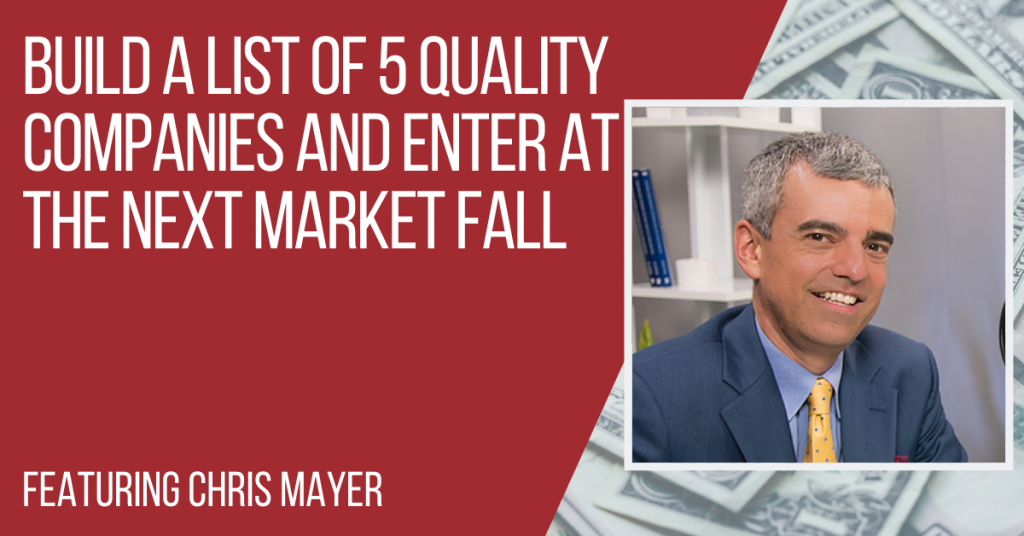
Ep249: Chris Mayer – Build a List of 5 Quality Companies and Enter at the Next Market Fall
Listen on
Apple | Overcast | Stitcher | Spotify | Other
Guest profile
Chris Mayer is co-founder and Portfolio Manager of the Woodlock House Family Capital fund. He also blogs about the thing he loves the most, investing. He started his career as a corporate lender, which taught him about managing risk and how business works.
Next, he started his newsletter, called Capital & Crisis, which led him into 15 years of writing investment newsletters.
Chris has written four books: Invest Like a Dealmaker: Secrets from a Former Banking Insider; The World Right side up: Investing Across Six Continents; 100 Baggers: Stocks That Return 100-to-1 and How To Find Them; How Do You Know? A Guide to Investing, Wall Street, and Life.
“Valuation is important, but it’s secondary to quality. I won’t buy something just because it’s super cheap if it doesn’t have all the other quality aspects that I like.”
Chris Mayer
Worst investment ever
Seeing opportunity in market panic
When the 2008 financial crisis slammed the US economy, fear dominated headlines and portfolios alike. But while many investors froze, Chris saw opportunity. Like countless others who viewed the crash as a once-in-a-generation buying window, he believed this was the perfect moment to start investing in stocks.
Chris’s logic was simple and, on the surface, sensible: buy what’s cheap and avoid what looks expensive. With markets in free fall, bargains seemed everywhere. Chris set out to scoop up companies trading at low prices, convinced that he could always sell them later once prices recovered.
It felt disciplined. It felt rational. And it felt like classic value investing.
But there was a subtle flaw hiding in that logic.
Cheap is just cheap
What Chris later realized is that many of the companies he bought weren’t great businesses that happened to be undervalued. They were simply cheap for a reason.
Many operated in cyclical, capital-intensive industries such as natural resources and energy. Some lacked durable competitive advantages. Others had weak business models that didn’t support long-term compounding. They weren’t built to grow steadily over decades.
As markets recovered, some of these stocks did bounce. Chris sold positions as they hit price targets or showed modest appreciation. While these trades worked “on paper,” the results were underwhelming. He made money, but not transformational money.
More importantly, none of those positions became long-term compounders. Years later, Chris owned none of the stocks he had bought during that period.
The real opportunity he missed
At the same time, Chris passed on what he now sees as the real opportunity of that crisis: buying the very best businesses when they finally became reasonably priced.
High-quality companies such as Visa, Mastercard, Costco, and Danaher, as well as other elite operators, were also down significantly. Even after falling, they still looked expensive compared to deeply distressed names. Because of his value-first mindset at the time, Chris skipped them.
In hindsight, those “expensive” companies went on to become massive long-term winners. They recovered quickly and continued compounding for years and decades. Had Chris bought just one or two of those instead of a basket of cheap stocks, he likely would still be holding them today.
His worst investment, in his own words, wasn’t a single disastrous stock. It was a mental model mistake: prioritizing cheapness over business quality during a rare market-wide selloff.
Lessons learned
- Buy the best, not the cheapest: Chris’s biggest takeaway is that during broad market selloffs, investors should flip their instincts. Instead of hunting for the cheapest names, those moments are often the best time to buy elite businesses at rare discounts.
- The best companies rarely look cheap in normal markets: Crashes are one of the few times when long-term compounders trade at prices that make sense. Those are the moments to act.
- Investing is a long-term game: From studying “100-bagger” stocks, Chris learned that massive returns take time. Many of the greatest performers took 20 to 25 years to deliver their full gains. Short-term rebounds can’t compete with decades of compounding. Cheap stocks may bounce. Great businesses compound.
Andrew’s takeaways
- Don’t be lured by a low price. Andrew compares cheap stocks to buying discounted clothes that don’t quite fit. The price may be attractive, but if the underlying quality isn’t right, it’s rarely a great decision.
- Just because something is cheap doesn’t mean you should buy it.
- Low prices can distract investors from what truly matters: business quality, durability, and long-term economics.
Actionable advice
Chris’s most practical advice is simple and powerful: Create a list of five outstanding businesses you would love to own for the next 10–20 years. Follow them. Learn them. Understand how they make money and why they are exceptional.
Then wait.
When the next market correction or crash comes, and those stocks fall 20% or more, that’s your opportunity. Instead of scrambling for the cheapest option, you’ll already know exactly what you want to buy.
This turns fear into preparation, and preparation into long-term advantage.
No. 1 goal for the next 12 months
Chris’s number one goal for the next 12 months is to find one high-value investor.
Parting words
“Don’t give up. Be patient. It’s a tough game. Everyone makes mistakes, so you just got to keep soldiering on.”
Chris Mayer
Connect with Chris Mayer
Andrew’s books
- How to Start Building Your Wealth Investing in the Stock Market
- My Worst Investment Ever
- 9 Valuation Mistakes and How to Avoid Them
- Transform Your Business with Dr.Deming’s 14 Points
Andrew’s online programs
- Valuation Master Class
- How to Start Building Your Wealth Investing in the Stock Market
- Finance Made Ridiculously Simple
- Become a Great Presenter and Increase Your Influence
- Transform Your Business with Dr. Deming’s 14 Points
Connect with Andrew Stotz:

About the show & host, Andrew Stotz
Welcome to My Worst Investment Ever podcast hosted by Your Worst Podcast Host, Andrew Stotz, where you will hear stories of loss to keep you winning. In our community, we know that to win in investing you must take the risk, but to win big, you’ve got to reduce it.
Your Worst Podcast Host, Andrew Stotz, Ph.D., CFA, is also the CEO of A. Stotz Investment Research and A. Stotz Academy, which helps people create, grow, measure, and protect their wealth.