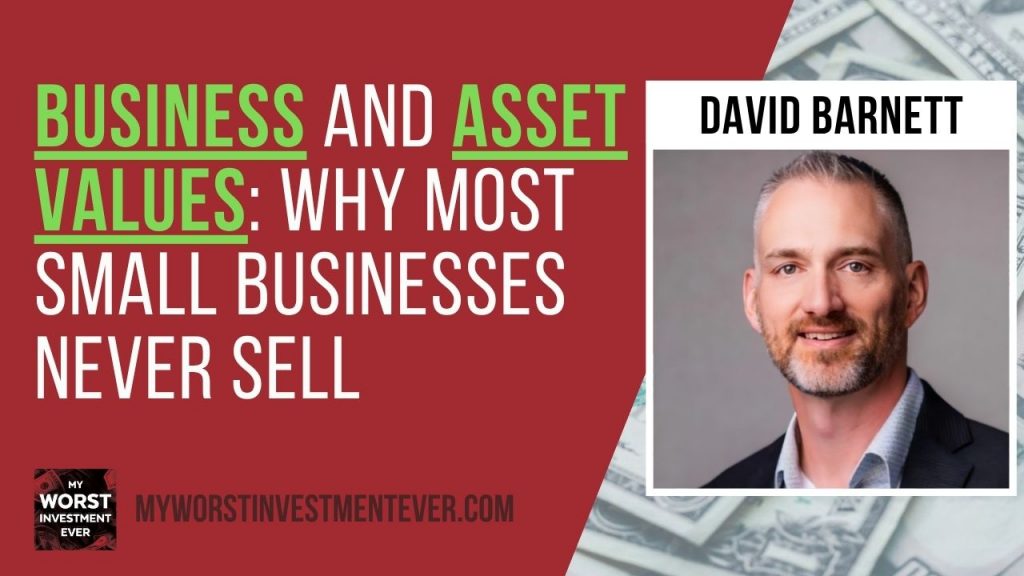
Ep825: David Barnett – Business and Asset Values: Why Most Small Businesses Never Sell
Listen on
Apple | Listen Notes | Spotify | YouTube | Other
Quick take
BIO: As an author, consultant, and international speaker, David C. Barnett has helped thousands of entrepreneurs avoid bad deals and close successful ones.
STORY: Seven years after his first appearance discussing tax-related business losses, David returns for his third visit to unpack the biggest myth in small business acquisitions: that a wave of retiring baby boomers is about to flood the market with cheap businesses for sale. The real numbers tell a very different story, and most of what actually kills a deal has nothing to do with supply and demand.
LEARNING: Value is never a fixed number; it depends entirely on who is asking and why.
“Success is not closing the deal. It is buying a successful cash-flowing business at a reasonable price that’s going to allow you to get a reasonable rate of return—or you avoid a bad deal.”
David Barnett
As an author, consultant, and international speaker, David C. Barnett has helped thousands of entrepreneurs avoid bad deals and achieve successful business deals. His YouTube channel and podcast reach a global audience of small business buyers and sellers.
David joins the podcast for a third time to discuss his newly released book, Business and Asset Values, and the realities of buying and selling small and mid-sized businesses today.
The “silver tsunami” myth, debunked
There is a lot of buzz right now about a coming wave of business sales, driven by baby boomer owners hitting retirement age. David has heard the pitch many times, and he does not buy it. The theory goes that this surplus of retiring owners will flood the market and drive prices down. But supply and demand only work that way if the pool of buyers stays fixed, and in small business, it does not.
David uses his own 17-foot aluminum canoe to make the point: he already owns one, so no price will convince him to buy a second. Most consumer goods work that way. Small business acquisitions do not.
Successful buyers that already own profitable businesses have no limit to how many other new businesses they can also acquire. And so the competitive forces at play when a good private business comes up for sale are just as vigorous as they always have been. The businesses that struggle to sell were always going to struggle, tsunami or not. BizBuySell, one of the largest business-for-sale marketplaces, reports that roughly 70% of listed businesses never sell.
Why most listed businesses never sell
According to David, most listed businesses never sell due to dead capital. These businesses have equipment or assets that cost money but do not generate a return, which makes the business harder to finance and harder to sell. If a buyer would have to borrow money to pay fair value for those assets, and the resulting cash flow doesn’t cover the debt service, the deal simply doesn’t work, no matter how much the owner believes their business is worth.
David adds that public companies are often valued on their future because investors are buying an experienced leadership team along with a plan. Small businesses, on the other hand, are valued almost entirely on their past, because when the owner leaves, most of the knowledge and relationships that made the business work leave with them. Buyers want to see the history proven out, not projected forward, which is one reason small businesses trade at much lower multiples of cash flow than anything publicly traded.
Seller’s discretionary earnings (SDE)
Another factor that affects a business sale, David says, is seller’s discretionary earnings (SDE), which is EBITDA plus the owner’s salary. A healthy SDE margin usually falls between 10% and 20%. Above 40% is a red flag worth investigating, and below 5% requires looking for what is off, whether that is pricing, high costs, or high gross margins. Often what turns up is unrecorded sales or personal expenses run through the business to lower its tax bill. That kind of underreporting can make an otherwise sellable business unbankable, since no lender will finance a deal built on numbers the owner cannot legally document.
Financing also shapes a business’s price. A business worth $800,000 with only $400,000 in tangible assets might get a loan for $300,000 in Canada or Europe, leaving the buyer to bridge the rest with their own equity and seller financing, often 30% to 40% of the deal. Easier access to credit pushes prices up. The same business in Ontario, Canada, and across the water in upstate New York will typically sell for around 25% more on the American side, simply because more buyers there can access the financing to pay for it.
What actually counts as a “small” business
David’s advice for anyone in a conversation about “small business” is to stop and ask for a definition. The Harvard Business Review Guide to Buying a Small Business describes a small business as one with $10 million in revenue, a number that would strike most of David’s own clients as anything but small.
He prefers to define businesses by EBITDA rather than revenue. He notes that, mostly, main street businesses run under $500,000 in EBITDA, and the lower middle market stretches up toward $1 to $1.25 million. Revenue alone can be misleading, since a business with high cost of goods sold could post $30 million in revenue while the owner takes home only a couple hundred thousand dollars with a dozen employees, a small, family-run operation in every practical sense.
Entrepreneur or business owner? The difference is growth
David drew a distinction between two very different relationships people have with their businesses. Many main street business owners started out simply needing an income, built the business to the point where it supported their lifestyle, and then settled in, sometimes for 15 or 20 years, focused on sustaining what they built rather than growing it further.
An entrepreneur, by David’s definition, never really stops adjusting the business, always trying to make it better, faster, leaner, and more profitable. A business that is not growing can still be a perfectly good source of income, but it is playing a different game entirely from one built to keep compounding in value.
Why you should read David’s book
David says reading his book Business and Asset Values: How Owners, Buyers, Sellers, Lenders, and Advisors Should Think About Small Business and Equipment Values will help business owners avoid bad value conversations. This is something that David has consistently seen throughout his career, where people will have different advisors give opinions on value, and they’ll start arguing about the numbers when, in reality, they need to understand what someone’s going to do with the asset. The book will help you think about your purpose, why you want something, what you’re willing to do, and how far you’re willing to go for it.
No. 1 goal for the next 12 months
David’s number one goal for the next 12 months is to get his second child through high school and out of the house, after his daughter left for university. Then he can start doing the things he loves without guilt.
Parting words
“If you are thinking of getting involved in or owning a small business, then it makes sense to pick up this book. It will help you have smarter conversations with clients and understand why someone holds a certain position. It’s going to give you an advantage in empathizing so you can have better conversations and a better position in any kind of negotiation.”
David Barnett
Connect with David Barnett
Andrew’s books
- How to Start Building Your Wealth Investing in the Stock Market
- My Worst Investment Ever
- 9 Valuation Mistakes and How to Avoid Them
- Transform Your Business with Dr.Deming’s 14 Points
Andrew’s online programs
- Valuation Master Class
- How to Start Building Your Wealth Investing in the Stock Market
- Finance Made Ridiculously Simple
- FVMR Investing: Quantamental Investing Across the World
- Become a Great Presenter and Increase Your Influence
- Transform Your Business with Dr. Deming’s 14 Points
- Achieve Your Goals
Connect with Andrew Stotz:

About the show & host, Andrew Stotz
Welcome to My Worst Investment Ever podcast hosted by Your Worst Podcast Host, Andrew Stotz, where you will hear stories of loss to keep you winning. In our community, we know that to win in investing you must take the risk, but to win big, you’ve got to reduce it.
Your Worst Podcast Host, Andrew Stotz, Ph.D., CFA, is also the CEO of A. Stotz Investment Research and A. Stotz Academy, which helps people create, grow, measure, and protect their wealth.