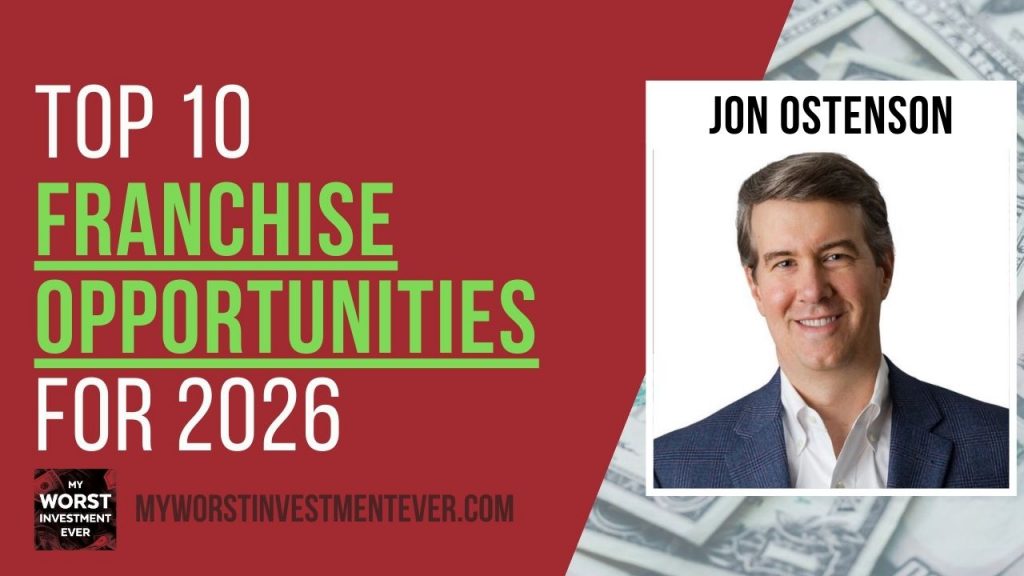
Ep817: Jon Ostenson – Top 10 Franchise Opportunities for 2026
Listen on
Apple | Listen Notes | Spotify | YouTube | Other
Quick take
BIO: Jon is the Founder and CEO of FranBridge Consulting, a 2-time Inc. 5000 company, and a leading franchise consultant.
STORY: Jon believes franchising remains one of the most effective ways to build durable income, especially when investors focus on operational discipline and unit economics. He shares his top franchise categories for 2026.
LEARNING: Look for businesses with repeat customers, operational discipline, proven unit economics, and leadership teams that have already made their mistakes.
Guest profile
Jon Ostenson is the Founder and CEO of FranBridge Consulting, a 2-time Inc. 5000 company, and he is a top 1% franchise consultant. Jon is also the author of the bestselling book, Non-Food Franchising. Jon draws on his experience as a former Inc. 500 Franchise President and Multi-Brand Franchisee in helping his clients select their franchise investments.
For many aspiring business owners, the biggest financial losses don’t come from bad intentions. They come from underestimating complexity, overestimating scalability, or betting everything on an unproven idea. Jon Ostenson knows this lesson intimately.
As the founder and CEO of FranBridge Consulting and franchise consultant, Jon has spent years helping entrepreneurs shortcut costly mistakes by investing in proven, non-food franchise models.
In Episode 815: I Built a Million-Dollar Business That Never Made a Profit, he openly shared how he once built a million-dollar business that never made a profit. That experience now informs how he evaluates opportunities with discipline, structure, and risk control.
Looking ahead to 2026, Jon believes franchising remains one of the most effective ways to build a durable income stream, especially when investors focus on operational discipline and unit economics. Below are his top franchise categories for 2026, and more importantly, why they help investors avoid the common traps that sink new businesses.
Why Franchising Can Help Investors Avoid Big Mistakes
One of the most common investment errors is assuming passion alone will overcome operational complexity. Many entrepreneurs love an idea but underestimate the systems, staffing, pricing discipline, and capital required to make it profitable.
Franchising addresses this risk by offering something rare: a business model with historical data. Instead of guessing whether pricing works or whether customers will pay, franchisees can examine real-world performance, talk to existing owners, and follow systems that have already survived market cycles, helping investors feel confident in demand-driven, structured opportunities.
Jon emphasizes that franchising is not about eliminating risk. It’s about trading unbounded risk for structured risk, supported by systems, training, and benchmarks.
1. Cost Mitigation Consulting: Profits Without Payroll
Cost-mitigation franchises help small and medium-sized businesses reduce expenses by analyzing vendor contracts, utility bills, shipping costs, and other fees. Clients pay nothing up front and instead share a percentage of the savings.
What makes this model compelling is its simplicity. There’s no inventory, no employees required, and no large infrastructure investment. Franchisees focus on business-to-business sales while the franchisor provides analytical support and benchmarking tools.
From an investment standpoint, this avoids two common mistakes: high fixed costs and overstaffing before revenue stabilizes.
2. Freight Brokerage: Leveraging Collective Buying Power
Shipping costs remain a pain point for businesses, and freight brokerage franchises sit neatly between companies and major carriers like UPS, FedEx, and DHL.
Rather than competing on price alone, franchisees act as trusted advisors, simplifying logistics and negotiating better rates using collective buying power. Technology and systems are already in place, preventing the trial-and-error phase that sinks many startups.
This model rewards consultative selling skills while insulating owners from volatile commodity pricing.
3. Digital Billboard Advertising: Recurring Local Revenue
Digital billboard franchises install advertising screens in high-traffic locations such as medical offices, oil change centers, and waiting rooms. The screens are free for host businesses, while advertisers pay for exposure.
The appeal here lies in predictable recurring revenue and minimal staffing. Franchisees sell local advertising while the franchisor handles content delivery, technology, and procurement.
It’s a classic example of monetizing attention without carrying inventory or managing complex operations.
4. Senior Fitness and Stretching Services: Demographics at Work
With thousands of Americans turning 65 every day, senior-focused services remain one of the strongest secular growth trends. One franchise Jon highlights provides on-site stretching and fitness programs inside senior living communities.
Revenue is recurring, demand is non-discretionary, and the business directly improves quality of life. For investors, this reduces reliance on consumer whims and economic cycles.
5. Home Mobility Solutions: Aging in Place Is the Future
Another senior-focused opportunity involves installing wheelchair ramps, stair lifts, and bathroom modifications to help seniors stay in their homes longer.
Jon favors this franchise because the leadership team brings decades of industry experience, and market demand is structural rather than trendy. These services align closely with healthcare, reverse mortgages, and long-term aging trends.
For investors, it’s a reminder that boring, needs-based businesses often outperform exciting ideas.
6. Pilates Studios: Premium Wellness With Predictable Revenue
Pilates franchises continue to stand out as one of the strongest performers in the wellness space heading into 2026. Unlike trend-driven fitness concepts, Pilates benefits from longevity, broad demographic appeal, and a reputation for low-impact, high-value results. Clients range from young professionals to older adults focused on mobility, posture, and injury prevention.
What makes this model attractive from an investment perspective is its membership-based recurring revenue and disciplined unit economics. Franchise systems have refined pricing, instructor certification, class capacity, and studio layout to maximise margins while maintaining quality. Jon highlights that these brands succeed not because fitness is exciting, but because their business models are structured, repeatable, and proven across multiple markets.
For investors looking to avoid the mistake of underestimating operating complexity, Pilates franchises offer a clear framework for scaling without reinventing the wheel.
7. Recovery and Wellness Studios: Riding the Longevity Economy
Recovery-focused wellness franchises are another category Jon believes will accelerate into 2026. These studios offer services such as cold plunges, infrared saunas, cryotherapy, compression therapy, and contrast bathing, all designed to support recovery, performance, and long-term health.
Unlike traditional spas, these franchises position themselves as ongoing wellness memberships rather than one-off luxury visits. Customers come weekly, sometimes multiple times per week, creating predictable cash flow and strong client retention. Demand is driven by athletes, busy professionals, and aging consumers who prioritise longevity and preventative health.
From an investment standpoint, these franchises succeed when operators follow disciplined rollout plans, resist overbuilding too quickly, and rely on franchisor-tested marketing and pricing strategies. Jon notes that many independent wellness studios fail not because the demand isn’t there, but because owners misjudge costs, staffing, or market readiness, mistakes that strong franchise systems are designed to prevent.
8. Music Education Studios: Community-Based Recurring Income
Music lesson franchises create centralized spaces where instructors teach children and adults under a standardized curriculum. Parents are willing to invest in their children regardless of economic conditions, making this category resilient.
The franchise advantage lies in marketing systems, scheduling technology, and curriculum design. Owners focus on community engagement rather than building everything from scratch.
9. Teen Driving Schools: Regulation Meets Opportunity
In many US states, formal driver education is required for teens to obtain a driver’s license. Yet the market remains fragmented and unsophisticated.
Franchised teen driving schools offer standardized training, vetted instructors, and strong brand trust. For parents, safety matters. For investors, regulation-backed demand provides stability.
10. Property Services: Flooring and Junk Hauling Reinvented
Jon closes his list with two property services franchises that stand out due to operational innovation. One refinishes hardwood floors in a single day without sanding. The other reimagines junk hauling by charging by weight rather than volume, dramatically improving margins.
These businesses benefit from strong cash flow, fragmented competition, and clear differentiation. They also attract private equity interest, which supports higher exit multiples down the road.
The Bigger Lesson: Avoiding the Same Investment Mistakes
Across all ten opportunities, Jon’s philosophy is consistent:
- Don’t chase novelty.
- Don’t underestimate complexity.
- Don’t assume growth equals profit.
Instead, look for businesses with repeat customers, operational discipline, proven unit economics, and leadership teams that have already made their mistakes.
Franchising doesn’t guarantee success, but it dramatically improves the odds by replacing guesswork with structure.
Final Thought
If there’s one lesson Jon Ostenson’s journey reinforces, it’s this: the most expensive investment mistakes usually come from building alone. Learning from others’ failures, using proven systems, and choosing businesses with real demand can mean the difference between surviving and thriving in 2026 and beyond.
Andrew Stotz 00:01
Paul, Hello, fellow risk takers, and welcome to my worst investment ever, stories of loss to keep you winning. This is an interesting episode because I found one of my recent interviews fascinating and so fascinating that I ordered his book online and have been through the book called non food franchising. And his name is John Austin. And if you want to learn more about him, you can go to Episode 815, where he talks about how I build a million dollar business that never made a profit, and that was his worst investment ever. It was a fascinating one for me, because he revealed some things that you know, that it's hard to scale a business as an example, and how do we standardize and yet still get all the revenue that we need? Now, John is the founder and CEO of Fran bridge consulting, a two time Inc 5000 company, and he is a top 1% franchise consultant. And as I mentioned, he's written the book, non food, frying, franchising, which is a great way it's, you know, it's not an overwhelming read. It's a great way to understand what he's talking about. So John, welcome back to the show.
Jon Ostenson 01:16
Hey, Andrew, appreciate you having me back. Excited to be here. Yeah, you
Andrew Stotz 01:20
know what I was just so fascinated because, you know, I've started a few businesses. Let's say I would, it's about four or five. Maybe one was like, Yeah, almost nothing. But let's say four businesses, and two of them survive, and two of them have, you know, made and are making good money and are growing relatively well, but it was a brutal road to get to this point. And I when I listened to our conversation before about franchising, I started thinking, Yeah, you know, I've always seen franchise going on, but I never really got it, and maybe just for a moment, tell us about kind of you know what you're doing, and you know why, why you're so darn interested in franchising, before we get into the top 10 franchise opportunities for 2026 Yeah, absolutely. You know,
Jon Ostenson 02:14
like many of your listeners, yeah, I spent many years in the corporate world and always wanted to be an entrepreneur. And I know a lot of your listeners are entrepreneurs. They have their small businesses, but never had that million dollar idea, and really didn't have franchising on the radar until some providential circumstances, and had the opportunity to come in and run a large franchise system and really fell in love with the franchise model. Had that light bulb moment where I saw all these diverse backgrounds coming around together under a shared system. Prior to that, I thought of franchising as just being fast food, but there's this whole world of opportunities, which we'll dig into in a minute, that exists outside of food. And so now, in addition to owning franchises myself, I also consult and help others that are looking to get in the game, identify the top opportunities for them that are looking to grow in their market. Entirely free to work with us. I'm essentially a real estate broker, but for franchises, we simply get a referral fee, very clean model. Love what we do. Love that we've gotten helped so many, you know, would be entrepreneurs become small business owners,
Andrew Stotz 03:10
yeah, and you know, I was looking at in your and in your book, and towards the end, you talked about long term strategies. And you know, one of the ones that I thought was fascinating is complementary portfolio. So maybe you can just talk, what do you mean? What's attractive for a person considering a franchise as a complementary portfolio?
Jon Ostenson 03:34
Absolutely, you know, a couple of examples to illustrate that. I had a client that was a real estate broker here in Atlanta, very successful. Had built a team, and he wanted to start a property management business. He got tired of referring people out to third parties, and so he came to me and said, John, should I start my own property management business, or should I get into a franchise? Would that be a better path? And, you know, I introduced him to some of the top players in the market. He eventually chose to go with one of them. And his feedback was, hey, it just shortcuts our path to success, right? I mean, could we do this ourselves, maybe. But hey, why not step in where we already have a technology stack, we already have the marketing ready to go, we already have the training for our team. It just shortcuts the path. You know, another example would be clients of ours in Boise, Idaho that bought an in home senior care business. You know, those are very high in demand these days, right? And several months in, they came back and said, Hey, what's the complementary business? And I introduced them to one that they eventually went with, that provided wheelchair ramps and stair lifts and bathroom retrofitting, allowing people to age in place in their homes. Great compliment to their core business.
Andrew Stotz 04:38
Yeah, that's that's that's fascinating. And when I think about that complementary, I have two examples in my own life. One is, they're not franchises, but they could have been, or still could be. One of them is, I have, you know, a coffee business, and we sell coffee to hotels, restaurants, coffee shops, so B to B. And recently, we found a great water supply. Liar out of Sweden, and they it's called blue water, and it's incredible water filtration system that then allows you to add back minerals through an app to get kind of the perfect water for espresso. So when you think about coffee business, you know, we roast coffee, but you got to have a machine to make the espresso. You got to have water, right? You need to have a barista, or at least someone, to push a button, if it's an automated machine. And so this just gave us one more complimentary thing. And just as a side note, we also previously went into flavors, and we realize it's not really complementary for us. We want to be focused on core coffee products, and that water is one example of a complementary the other one is that I have been doing advising. I work with a firm, and I give an investment portfolio to that firm, and then they vet it, and they bring it out as an advisory firm to their clients. But what I realized is that the strategies that I'm developing, I could also create mutual funds on the back of that, you know, and use that and so then I've expanded into what is a complementary aspect. So let's just talk briefly about this, you know, this concept of complementary a little bit more, because I want, I want people to think, you know, like, think beyond what you're doing right now.
Jon Ostenson 06:36
Yeah, absolutely. And, you know, I think one of the things I love about franchising is the optionality it gives you, right? You can expand through complementing your current business or your current franchise. A lot of our clients will also look to diversify and go with something totally different, and they start to build these organizations. I've got a client that is the largest franchisee of two men in a truck, operates a $45 million business across 12 markets. But every year or two, he comes to me says, Hey, John, I've got this young guy in my organization that I want to promote. What franchise Do you like for him, you know? And I'll introduce him with some ideas, and he'll go with one and give that guy a piece of the cap table and let him run with it, you know. And he's just had a great track record. So he's attracting great talent to his organization because he's creating these career paths for them within so a lot of different ways. You know, one things I like about franchising too. Is several years in, you may look around and say, I want to expand, but I've got franchisees all around me. I'm kind of landlocked. Well, you're going to get first dibs on anyone that's potentially selling, allow another franchisee to have an exit, allow you to expand, or vice versa, right? And so that it's what I call internal M and A that you get essentially first line of sight into potential deal flow within a business that you already understand. So a lot of different ways, but no, from a complementary standpoint, I love seeing different ideas come together. And sometimes it's complementary from a customer standpoint, you know, from an industry standpoint, sometimes it may just be complementary from a personnel standpoint, on the back end, or maybe you have a shared home office that's supporting a pool cleaning business and a roofing business. I wouldn't call this complementary necessarily, but on the back end, they're a lot of the same admin functions, right? Interesting.
Andrew Stotz 08:13
And then, and then, last thing I'll mention about the book is, let's talk briefly about diversifying portfolio, because let's imagine that you're in a business and you're thinking, I'm not that confident about the future. I have one of my clients, and they sometimes say to me, we're afraid AI is going to destroy our business area. Let's talk about the concept of using franchise to diversify your investments.
Jon Ostenson 08:38
Absolutely, we have that conversation every day, every couple hours, the drum beats getting so loud around AI these days, you know, I talk with clients that own technology firms or marketing agencies, consultants. Marketing agency I used to use personally is now coming to me saying, Hey, we're tired of doing this. We're ready to get into franchising. So it is fascinating to see the dynamics at play. But in some cases, they are looking to keep that day job or their current business, and they're looking to add another revenue stream. Now I never once sugar coat it. I tell them, if business ownership is easy, everyone would be doing it. So it does take work to start another revenue stream, but it also takes having a good operator. You know, the franchising if you have a good operator, if you've got a good franchiser on the sidelines, supporting that operator, it does allow you to continue with your main focus and not have to carry that daily support water for your operator.
Andrew Stotz 09:24
Yeah, I have, you know, I have this cool device on my computer, but I don't know if it works. So I'm going to just test it for a second to see I'm going to, I'm going to try to press a button and see if any sound comes across. Tell me if you hear anything. Nope. Okay. All that time I thought I had it figured out, but don't have it all right. I was going to give a round of applause after each one of the 10, but let's get started. Let's get into it, and let's get started with the first one you want to talk about of the top 10 for. Franchise opportunity for 2026
Jon Ostenson 10:02
gosh, you know, picking a top 10 is like picking your favorite kids, right? So there's so many directions I could go with this, but, you know, we'll start out. A lot of those that we work with have a B to B background. That's just very common. And you know, within franchising, I'd say B to C is a little more common just from how many opportunities you have in that bucket versus, you know, B to B, business to business. But we'll start out with a couple of B to B ones that we like. And this is a business that can actually be run without any employees, which is beautiful, right? But it's a cost mitigation business, so you're working with small and medium sized companies, helping them reduce their cost entirely, no cost to them to bring you in, but you're coming in evaluating their invoices, looking at their vendor agreements, and the value that you're able to provide is a you've been trained in knowing where to look for cost savings and kind of how to benchmark their cost versus what the industry what they should be paying. And then you're also able to leverage on the back end, the buying power of all these small companies now and give them the power that collective buying power, so you're able to come back with some prescriptive recommendations. They then pay you a percentage of those savings on an ongoing basis. You know,
Andrew Stotz 11:05
there's a publicly listed company that I would say, in some ways, is like that. It's called fast and all in the US, and they embed themselves in your inventory system, and then take it over, and then they dig out every single possible cost savings that they could find. So that is fascinating. And the person who is doing that, if you decide to do that franchise, you would be trained by the what do you call it, the franchise,
Jon Ostenson 11:31
or franchise? Or, Yep, exactly. You'd be trained. And they would also handle a lot of the analysis on the back end as well. So it's a little more of a sales type role. So if someone has that B to B sales background, this could be a great fit for them. And there's something like 25 different categories of cost that they know how to go in and analyze. So very holistic, incredible.
Andrew Stotz 11:52
And I already like that one for myself, selfishly. So there's number one, the cost mitigation business. What would you say is number two, not in any particular order, but, you
Jon Ostenson 12:03
know, yeah, we'll stick with the themes here of it, you know, we'll look at two more in the B to B services arena, just knowing those are popular. So this next one is what I would call freight brokerage. If you're a small or medium sized company. Oftentimes, if you are, do a lot of shipping. You know, with DHL or FedEx or UPS, you're calling a one 800 number, where this company comes in is they kind of stand in between. In between you and the carrier. So you're still using those carriers, but now you've got someone that, again, is able to provide better pricing because of the collective buying power that they're able to leverage. They're also able to be consultative and prescriptive, because they become the subject matter experts in all things shipping. So you're their go to shipping contact. You've got the technology allowing, you know, just very streamlined operations. Of course, there's more complexity to all this than I'm making I'm making it sound easy, right? There's complexity on the back end, but no, it's one that we're really excited about. Started in the UK, sold out in the UK, entered the US this past year, and we just placed some clients in Texas. And expect this one to grow really fast.
Andrew Stotz 12:59
And so if you were doing this freight brokerage business, you would basically go to people who are, who are doing a lot of shipping and freight, you know, and you'd say, I got an easier solution for you. You know, you're doing all this calling and talking all these different people trying to manage these relationships. And what do you know about you don't know anything about them, or anything about what opportunities are there. We're experts in that give it to us, and then we can not only take a lot of trouble and time off your hands, but we can also bring down your costs.
Jon Ostenson 13:28
You'd be a great sales guy. Oh man, got it. You nailed it.
Andrew Stotz 13:32
Okay, that's an interesting one too. I was wondering how interesting they would be, and I think they are interesting so far.
Jon Ostenson 13:39
Well, great. Well, great. Well, hopefully we'll keep that theme going. All right. So number three, the last one in the speed to be services arena, is one that provides digital billboards. So that's a fancy way of saying TV screens, advertising screens. You know, you see these in your doctor's offices. You see them in your oil change, you know, locations, I mean everywhere, right? And it's entirely free in this case, for the business owner to have that installed in their location, provide some entertainment to, you know, to their customers as they're waiting for appointments. But then your businesses are paying you to be shown on the screen, right? So you're really it's just local advertising. 101, great model around that. Again, you don't need a large team a little more sales oriented, just like the last two were as well. So very clean model. All three of these businesses you can get into for around 100,000 or even less. It's that, from a franchising standpoint, that's on the low end. For sure, you don't need infrastructure. You don't need a retail location. This is work remote scale. It at your own pace. But all the technology, a lot of the training, the lead generation, all that kind of supports on there from the franchisor.
Andrew Stotz 14:44
And for the digital billboards, what is the what's coming from the franchisor? They're there. You're buying the bill, the actual devices, and then they're bringing their expertise on how to program them. Or how does that work? Go how to sell them exactly.
Jon Ostenson 15:01
So there would be the training component, there would be the procurement, again, buying in bulk of the, you know, the actual product, the TVs, and then they're handling a lot of the administrative pieces around the streaming of the ads.
Andrew Stotz 15:15
So right there, if you said, Oh, I'll do it on my own, well, yeah, you're going to have to go out and pay a pretty high price for each one of those, versus working with this franchisor who can provide you a much lower price and all the support that you need.
Jon Ostenson 15:27
And Andrew, you'll appreciate this another value one day when you go to sell your business. There's been research done that's shown that franchises trade at a higher multiple than non franchises. In most cases, it's like a one and a half multiple you know, in non food franchises. So there's value from a potential buyer as well.
Andrew Stotz 15:45
That's page 38 and that is the reference you make to John P Hayes, David Smith and Mary Kay Copeland's research at the Rinker School of Business faculty, and the conclusion they came up with after examining 2100 159 business resales over a 10 year period. The researchers found that the franchise businesses sold at a 1.5 times multiple higher than non franchise businesses. So if you thought you're going to sell your business for a million dollars, if it was a franchise, you could sell it for $1.5 million that's the research I want to I want to get that paper and look at it myself and try to understand a little bit more about that, because that, to me, is one of the biggest things, because, you know, it's a little bit like people ask me, Why didn't you buy a condo in Bangkok? Foreigners are allowed to buy a condo. There's lots of beautiful condos. And I said, Look, if you want to buy a good condo in Bangkok, your minimum you're going to spend is a half a million dollars, but you probably need closer to a million. Now I'm going to put down a million dollars, let's say, and let's just say that I rent it, and I rent it for a yield of, after all the expenses into that, I rent it for a yield of, let's just say, 5% net yield, I guess 5% per year, which is pretty impressive, in my opinion. After all the costs and the agents and all them, then I bought it for a million. The question is, what am I going to sell it for in 10 years? 20 years, 30 years? In many, many cases, you're never going to sell it for more than what you bought it for but in the stock market, it's almost assured, not only I don't have to buy just one stock, I can buy a diversified portfolio of stocks. Rather than buying one condo, I could take that million dollars or half million dollars, put in a diversified portfolio. And the probability that I could, that I could earn, let's say, a 3% or 2% dividend yield is high, and that I could sell it for some sort of capital gain that would give me five to maybe 8% total average annual return over that period of time. So I'm going to get, let's say, a total return of 10% on that money. And it's just, I just don't see any way, but it's the same thing with business. Most people start up their business and they realize they and I see them at the tail end of it, where they realize we can't get a lot of value for this business, and that's not the case for franchises. So that's why I find this, you know, one of the many angles of fascination.
Jon Ostenson 18:18
Yeah, no, I think it's well said, and I love that you had the reference there. You're the perfect wing man, Andrew, I love hanging out with you. But let me say this, not every franchise is created equal, so I never want to make a blanket statement, right? You know, there are franchises. There's several 1000, right? So just like any industry, you're gonna have players that don't do a great job, that don't provide great support, right? And that's unfortunate, but it is what it is. But then there are ones that provide great support, and that's where support, and that's where we come in and try to help identify those. So again, I just want to make sure I don't make blanket statements from my end, implying, you know,
Andrew Stotz 18:49
everything, oh yeah, there's all kinds of mess everywhere. That's part of why we make excess money when we are entrepreneurs, you know, because we kind of sort through that mess. All right, we're now at number four, I think.
Jon Ostenson 19:01
Yeah, absolutely. So let's switch gears to the senior industry. You know, we've been talking about people turning 65 I think 10,000 turning 65 every day. We've been saying that for probably a decade now. Well, they continue to get older, right? And so we'll hit on two here. And when you think seniors, you think of in home Senior Care, right? And there are a lot of large players in that space. We've placed a lot of clients with In Home senior care, but to take two different approaches to it. One, there's a business that we actually just signed a client with today that provides stretching and fitness, and, you know, for seniors in senior placement facilities. So you'll come in provide the programming, you know, once or twice or three times a week, on a regular basis, recurring revenue. It's great, right? But you send your trainers in there that have been trained, and they go in and work with the seniors, yeah? So you're helping the community. It's a feel good business, and there's money to be had in it, yeah?
Andrew Stotz 19:50
And you know, when you think about the senior locations, they probably struggle to find somebody that's, you know, able to. Do proper stretching and fitness. And you know that's safe, and you know that's careful. I look at my mom, and I think, you know, for 2026 one of my goals at the age of 87 she is, right now, is probably more stretching, and it's hard to it takes a lot of time. You can't go at it hard. You can't, you know, you've got to go slow and steady, and very few people understand that I had a therapist, even that came in and did something very quickly with my mom and caused an injury that she still suffers from today. So having someone that's truly, you know, skilled in that area, is very valuable, all right, so that's exactly stretching and fitness on location,
Jon Ostenson 20:39
on location, right? But again, a mobile business, you don't need a physical location in this next one, same way, this next one, you would need some sort of industrial like, small footprint, you know, for receiving product and such. But it's a business that I'll give you a little more context around it. It provides wheelchair ramps, stair lifts. It retrofits the home, the bathrooms, you know, for mobility solutions, allowing people to age in place. A lot of times they don't want to go to the senior want to go to the senior center until the very end, right? They'd rather live at home. And so this one really allows them to do that from a mobility standpoint, and it's brand new. They just started the business recently. But the reason I have confidence in it is because the leadership team has 28 years of experience in the industry. The founder, I know extremely well. He built a very large business in this exact same industry. Took all those experiences and know how and best practices, and now put them into a new business that has open territories. The other one was completely sold out in the US, and now you've got open territories, just a large addressable market, you know, potential for owners to do well into the seven figures. Based on his prior experiences,
21:41
I have two words for him, reverse mortgage.
Andrew Stotz 21:48
That's right. My sister is a leader in reverse mortgage in Maine, and she's been doing it for a long time, and she understands it very well, but that's the whole challenge that people are faced with as they get older. Is I want to live in my home as long as I possibly can. And a reverse mortgage is a real commitment to say, I am committed to being in this home. I'm not going to sell it and move to another location or move into a and so there you have that commitment. And that would be the perfect opportunity for someone to say, and we're going to make it safer, and, you know, more we're going to help you. Yeah, I just think about the things in the bathroom that help make it easier. And so, you know, you know all of that. So reverse mortgages are my two words for that.
Jon Ostenson 22:32
One, absolutely, absolutely. And that's a needs based business right here. You know, this isn't something like, Hey, you know, it's not trendy, it's not going out of fashion, right? So, well, let's fast forward to the health and wellness. I'd say of all the categories, this is probably the most fashion for you know, you do have some that will go or along with trends. However, I'd say when you look at the longevity movement and where we are and where it's projected to be, projected being $8 trillion industry, 8 trillion worldwide over the next 48 months, according to UBS, they put some research out on that, but the first one we'll look at is Pilates. And there's actually two concepts that I really like in Pilates. Then they're not club Pilates. Club Pilates helped create the industry. Now we've got two second movers, experience, very experienced teams behind them, one that was actually part of club Pilates. So I can't pick a favorite between these two, because I like them a lot, but they're both modern Pilates. Great way of approaching it, some proprietary elements to each business as far as the equipment goes. And you know, if you're a Pilates junkie, then you would appreciate those differences. But the Pilates market is 100 and was projected a 140 billion worldwide last year, it's projected to grow to 450 billion to 500 billion worldwide over the next eight or nine years. So massive industry that's got a lot of momentum and a lot of room for growth. And so we really like both of those. The other one in the health and wellness space, we had a client just have a grand opening in he bought five locations of this business. I got to attend the grand opening. It was an awesome experience. But it's recovery modalities. So sauna, cold plunge, you know, cryotherapy, the red light beds, compression, they've got some injection injectables as well, all under one roof. So you see a lot of concepts out there that provide one or two things, but this provides them all. Provides them all under a membership model, and has just been growing really fast across the US. Again, a lot of people are doing multi location plays. That's a heavier investment. You're talking more about like half a million to get into one of those, versus some of these service based businesses that are more like 100,001 50 ish
Andrew Stotz 24:42
interest it's interesting, because I watched the progression happen in Bangkok. Originally, there was really no, you know, when you look at a developing country, everybody's pretty fit because they're farming rice and they're growing stuff, and they are laboring and they're building and they're not. Building phase. And so we didn't really have much in the way of fitness and stuff. And then all of a sudden we got our first yoga studio, and I used to go to that yoga studio, and many, many years ago. And then all of a sudden we got flooded with yoga studios. Because what do you need? You need a floor and a mat, you know. And so all of a sudden, people then moved into Pilates, because they Okay, well, capital investment is a little bit of a barrier to entry here with Pilates, but then we see a lot of those guys that were struggling to do the yoga ended up getting funding and launched Pilates. And you know, they're, they're having various different levels of success, but what is it from a franchise perspective. That would make it better for someone who's saying, I want to do I love the Pilates angle. I want to do more of that. Why would a franchise add value to you, if you were considering that?
Jon Ostenson 25:52
Yeah, everything from, I mean, really soup to nuts, from the build out at the very beginning, because most people have never built out a retail space, right? And so the design the build out very turnkey. They're handling a lot of that for you. It will really site selection even before that, and then from a launch, you know, oftentimes you have a membership based ready day one because you've done all the pre launch sales. So again, they're doing a lot of the training. They're running a lot of the marketing that's driving those sales. You know. Sometimes they'll even be on site, helping with those sales, you know. But then they've got merchandise. They've got all the systems set up, you know, the POS system, you know, the apps. It's just, could you do this on your own? Yes, would it take a lot longer, and would you probably spend a whole lot more money through trial and error. You also have an optimized marketing data set. Day one, they know how to launch these locations so they know what works what doesn't. So you're able to
Andrew Stotz 26:44
stay but you don't like business, that's probably the likelihood of what's happening in most cases. And so you go into Pilates, because you love Pilates, and then you realize, oh my God, there's so much I have to know and learn. And now you're on a 10 year learning curve, maybe you don't have the runway to even survive that, and so you end up crashing. Whereas here, yeah, you love Pilates, but you need to partner with someone who loves the business of Pilates. And so, yeah, that makes sense, yeah.
Jon Ostenson 27:13
And in a lot of cases, it's people that, you know, they just want to make money. They're not, you know, they may or may not love Pilates. A lot of our clients aren't passionate about what they're getting into. They officially become officially become passionate. They become passionate about helping people. It's not that vehicle that gets, you know, and so some people say, you've got to be passionate. Others say, Hey, we're good. We'll sell a bunch of, you know, porta potties if we make 2 million bucks doing it. Yeah.
Andrew Stotz 27:37
And I think that's where also, there's many Pilates studios that can get crushed by someone that comes in and says, I'm not like a Pilates expert. What I am is a business expert, a sales and marketing expert, a customer experience expert, a follow up expert. I'm all of those things, and Pilates is just a vehicle to implement all these great things that I am good at and that is hard to beat, and that, when it's a friend, when all that's rolled up in a franchise, then, yeah, I can see that value. Where, where are we at in numbers? Now we were where? What's our latest number? What was that?
Jon Ostenson 28:10
Yeah, so we just knocked out number six and seven. So we're moving on to number eight.
Andrew Stotz 28:15
Exciting, yeah, thought that would hit
Jon Ostenson 28:17
two in the kids space. People will always spend on their kids no matter what the economy is, right? And so the first one is really the only franchise I'm aware of that provides some music lessons. Now, this is a retail location, but it's a small footprint. All on investment are between 250 300,000 and there are ways to fund this. Andrew, like we've talked about before. You know, SBA loans are very common, or retirement plan rollovers through what's called the Rob's program. There are different ways to get involved. It's not all cash. All cash, but yeah, one that provides music lessons. I love the founders have gotten to know them well. They started with, you know, four or five studios, and now been selling locations all across the US. And you know, it's really not hard to staff these. It's if you're anywhere near a local college, they probably have a music program, and you're bringing in these part time instructors, you know, kids from those colleges, and again, a community benefiting business, and can make some pretty good money
Andrew Stotz 29:07
as well. Again, you feel like, ah, the barriers to entry is so low. Just, you know, somebody's gonna come along and say, I love music, and I love teaching music, and I My uncle has this space, and I'm gonna use it, and I'm gonna start teaching, and all of a sudden you could have three of those people pop up and compete with you in this. Why is it the smartest thing to do to do this as a franchise?
Jon Ostenson 29:31
Yeah, well, and I would ask, how many, at least, here in the US, how many music instructors have you seen open up their own studios? Right? I mean, usually they're they need a place to go, and so I think creating that space, it's almost like a shared office space. Office space or a shared salon space, right? With which are also both franchise concepts. So it's creating the space. And, you know, it's not rocket science at the end of the day. But again, there's a program that they follow, a lesson curriculum. Someone may be a music student, but they don't know how to, you know, what are those first steps in training a seven year old? You know, my daughter's taking piano lessons, and I've kind of seen it firsthand. So could you do it yourself? Possibly So, and that's a question you always want to ask when you're going through the franchise exploration process. Is what value am I getting from the franchise, or is this something I should go do for myself? So again, with that, they're providing a lot of the marketing. They do have the technology, systems, things that you could piece together yourself, just take longer and there may be more trial and error.
Andrew Stotz 30:25
Yeah, when I think about Thailand, in particular, about 50 years ago, we had almost very little hospitals. You know, they were mainly government run hospitals, so, but what we had was clinics, and every doctor basically had his own clinic. And then we had some hospitals, private hospitals, set up. And what they did is they presented, they gave a space. They created a space for doctors to say, Why are you sitting at your clinic? You know, come here and work with us, full time, part time, whatever you want. We're going to give you a little room that is your office, and you set your times when you want to meet patients. We get the flow of patients that'll be endless, you know, as many as you want to see. Yeah, you're not going to make as much as you may think you're making in your clinic, but are you really making that in your clinic? Look at all the trouble you have to hire the admin, the computer systems, the this that you got to do, the marketing, and all of a sudden these doctors just flocked out of clinics and into those hospitals where they created this space to have their clinic on site, basically. So I can see that concept of creating the space for music teachers for sure?
Jon Ostenson 31:42
Yeah, absolutely. Or the other one I thought I'd mention in the kids space is teen driving school. Now, in 35 US states, 35 of the
Andrew Stotz 31:51
50 wait teams are teaching how to drive.
Jon Ostenson 31:55
They're being taught, but, or they should be being taught, we'll hope. But in a lot of states, you know, majority of states, there are actually requirements that teens go through a driving school to be able to get their licenses. So, however, it's a very fragmented space, a very low sophistication out there. Some schools teach it, some don't. The feedback we receive is, oh, our community could totally use something like that, like and so there's certainly no large, branded player out there for the most part, right? That's doing it well. So, you know, great franchise guys behind this one, you know, they have a lot of experience. That's something I like to see in newer brands, is not only industry experience, but also franchise experience. On that team. They've been there, done that, supported successful franchisees and prior ventures. So, you know, like this one a lot, and see a lot of potential, and they're getting a lot of attention.
Andrew Stotz 32:40
And that that, I guess, is, when you think about that, that's could be for a person that says, I know everybody in my town, and you know, my town's got 10,000 people in it, 100,000 whatever that number is, and this franchise provides me an opportunity to set up a little business that does something and generates income for my town. I may not be interested necessarily, in expanding to the next town and the next town and the next town and the next town, but this could give me a plug and play that I can go in and dominate this one space in my town. Would that make sense?
Jon Ostenson 33:10
Yeah, absolutely no. And the franchise door is going to run a lot of the digital marketing. They'll be producing collateral, but yeah, anything you're able to do to sponsor the Little League baseball team, or get involved in the Chamber of Commerce or, you know, form those natural referral connections. I mean, that's business 101, right? That's great. And you can always tag on businesses to this, whether it be, you know, we've had clients do really well in youth soccer, like, really well in that space, there's a lot of adjacencies, I think that you could tag on once you have that customer base, yeah.
Andrew Stotz 33:39
And if any parent ever heard the story of my old, my old time best friend, Dave, who said that his driving instructor would smoke weed with him while he was driving. This was back in, you know, 19, you know, 79 or whatever you think. Yes, I would like some vetting done in my teen driving school. Please, please.
Jon Ostenson 33:59
You taught my story. My guy fell asleep, but he, I don't think he was smoking weed. Smoking weed.
Andrew Stotz 34:03
Yeah, yeah. I don't want my kids smoking weed with the guys trying to teach him how to drive. Yes, please. Thank you. None of that. So is that number 10?
Jon Ostenson 34:11
That was number eight. So we'll hit these last two real fast home and home and Property Services has probably been the most popular area over the last five years. A lot of private equity getting involved, a lot of smart money flowing in, just understandable, cash flowing businesses. And there's so many options I could share here, but two that will hit on real fast. One is a flooring business, the proprietary product, proprietary process, where they come in and they can refinish hardwood floors in a day without having to stand them, which is mind blown for those that have hardwood floors, like myself. The other business is junk hauling. Now there's some other large brands and franchising in the junk hauling space. One 800 got junk as an example, right? They help create that industry. But junk hauling is a $10 billion industry. There's a lot to go around. For the most part, it's pretty unsophisticated. This is a company that does things in beer. Differently. They actually charge by weight versus by volume. Well, you pay at the dump site by weight, so it makes sense to charge by weight, but no one else does that or can do it. So they've got a patented, you know, component of their truck that actually weighs everything, and they're able to provide estimates over the phone of what it's going to cost. And so in house call center, all very technology based differentiator. When they move to a weight based model. This company, they increase their gross margin from the low 40% range to close to 70% so it was a game changer, and now they're offering it as a franchise. I know the founder will think highly of their team and excited to
Speaker 1 35:40
get behind that one, and that's no junk.
Jon Ostenson 35:44
That's no junk. So we could talk all day about dumpsters. People love dumpsters. People love pets. There's so many you and I could do this all day, but yeah, there are 10 right there to help get people leaning in.
Andrew Stotz 35:57
Yeah, that's the fascinating you know, the junk hauling one. And you know, it's just more and more and more regulation going to be put in place of what you can do and can't do and all that. And when you look at countries also, you know, outside of the US, there's a whole upgrade that's happening, you know, in a lot of countries around the world in this space. And let's say you can, one of the interesting things is, you can look ahead and say the trends that are happening in the US, for people that are non US, can look at these trends and say, Okay, I can pretty much predict that's going to come to Thailand as an example, what franchise opportunity would give me the ability to enter that now, so that I'm prepared it could Be 10 years before, but I've got family, kids, whatever, and I want to build this over a long period of time. So that's another kind of angle from, from, let's say, non US or non developed markets. That's what I see. All right, is there any anything you want to add before we wrap up to this great list?
Jon Ostenson 36:57
No, that was so much fun. Appreciate you having me back and again. We could probably do this with another 10. Sometimes it's, it's a fun conversation. And yeah, love our interactions. You ask great questions. So yeah, excited about what's going on in the world of franchising. Certainly if we can help any of your listeners, again, entirely free to work with us. I'd encourage people to pick up, pick up our book, non food franchising, just by coming out to our website, Fran bridge consulting.com, I'm always happy to jump on a call if I can help in any way.
Andrew Stotz 37:22
And fantastic. And we'll have links to all that in the show notes. So, you know, reach out. This is, to me, a lot of interesting things. In fact, my last question is, how do you not get yourself invested in as many of these as possible? Like, some of them are just so tempting when you look at and I just love the niche aspect of really focusing in. I'm just curious for yourself, what is your strategy for, you know, investing or franchise or what, what is it that Do you ever get tempted into these things? And when you do, you know, how do you do that investment?
Jon Ostenson 37:58
Yeah, absolutely so. I'm invested in four franchises currently, three in the Property Services where, you know, one in the health and wellness, you know, everything from asphalt paving and line striving to a business that provides temporary walls, containment walls around renovation projects, construction sites. I kind of like those non sexy industries, you know, but I've got good partners, and they're overseeing most of the operations. So I'm more advisory at this stage, more capital partner from an involvement standpoint. But no, I'm going to all of the above. Investor, Andrew, I invest a lot in real estate, oil and gas, crypto, certainly the public markets. I believe the business ownership, and in particular, franchising, has a place in most people's portfolio. There's tax benefits that go with it. The government incentivizes it. So again, that's another conversation for another day, but I believe it's all of the above, not either
Andrew Stotz 38:44
or, okay. And my last question for today in that is we've talked about how if you were to get a franchise and run it for 10 years, you know, whatever, and then sell it, you have a much more higher likelihood of selling it at a higher price than if you had done that on your own. But let's just briefly talk about the idea of, yeah, sometimes you need capital partners. You need capital to grow. You know? Sometimes you may have other types of partners that come in. Now, if you are a business owner who's never done business before, and you've got to deal with the issue of, how do I get a partner? What contracts do I need in place? How does, how do we exit this or complete this relationship? If things go well, if things go poorly, where does franchise fit in? Kind of navigating that very tricky area of the cap table?
Jon Ostenson 39:38
Yeah, no. Partnerships are great till they're not right. I've had good partners. I've had bad ones. So I'm not an attorney, but I'm always happy to share my experiences. And, you know, I've seen a lot with clients of ours as well. Partnerships are very, very common in franchising, and it would operate just very much like a small business, you know, outside of franchising, and you'd have an operating agreement, and that would kind of spill out, who owns what equity, whether? Putting into it who's got voting rights or what have you. I always encourage people include the revolver clause, which essentially it's a Buy Sell clause. If ever you guys come to an impasse, one can offer to buy out the other one, and that person can then buy them out at that same price. So it kind of keeps you honest on what you're offering. So yeah, there are little things I've learned along the way, but partnerships are very common in franchising, oftentimes a capital partner and an operating partner.
Andrew Stotz 40:24
And when you go to sell, let's say, and sell a franchise, how difficult is that to sell it? Let's say you've done, you know, you got an area, you've done well in that area, you've followed all the guidelines, you've done it well. You've earned a lot out of it, and you want to go to sell it. How difficult or easy is it to sell that?
Jon Ostenson 40:47
I mean, certainly depends on the business, the market, a lot of variables. But then your first option is going to be to sell to another franchisee in the system, right? You put the word out there, who wants to expand? That happens. Most resales never hit the open market. Franchisee will buy them. It's been my experience. Secondly, you know, if no one wants to buy it for whatever reason, then you can put it on biz, buy, sell.com, you know, website gets a lot of eyes. You can use a local business broker. You can have the brand offer it to the broker networks out there. So, yeah, there's a lot of ways to get eyeballs on it. You know, the cheapest, most efficient way would be to have another franchisee, you know, buy it from, you know, from it. And technically, the franchise or has to approve that buyer, but it's in their interest to have the continuity of the business. And as long as you're not selling it some knucklehead, you know, they'll, in most cases, approve the person,
Andrew Stotz 41:36
yeah, and that's just a good, a good reason why you want to keep good relationships with the other franchisees around and get to know them. In some cases, there may be an active group that you get to know them, so that when it comes time you know, you think, I'm five years from now, I'm going to be out of this. You say to a couple of them, hey, not right now, but you know, five years from now, let's, let's talk. And starting that discussion, starting that thought process, you can probably get to a point where three years from now, you're having a conversation with one or two of those guys that say, Yeah, I'm at a stage where I want to, I want to expand this, and now I know how it works, and this is a really, relatively low, you know, risk situation for me to just expand to another geographical area that's, you know, neighboring and so, yeah, That seems like that could be pretty easy.
Jon Ostenson 42:22
Yeah, absolutely. Well,
Andrew Stotz 42:24
I want to thank you for coming back on the show and sharing this incredible list that just sparks so much thinking. This is the top 10 franchise opportunities for 2026 and as you said, we can go on and on, but for those out there who want to learn more about it, make sure that you go to John's website, which is called Fran bridge consulting.com, and you can learn all about it. So I'm going to give you the last word, anything you want to say to the audience,
Jon Ostenson 42:58
yeah, no, it's been a pleasure. Excited about 2026. I think it's gonna be a great year for entrepreneurship and business owners, and just so many tailwinds. They're com in, and, yeah, lower interest rates, a lot of macro factors that I think should bode well. So we're seeing a lot of interest, and would love to help any of your listeners. Fantastic.
Andrew Stotz 43:15
And ladies and gentlemen, I'll see you on the upside. You.
Connect with Jon Ostenson
Andrew’s books
- How to Start Building Your Wealth Investing in the Stock Market
- My Worst Investment Ever
- 9 Valuation Mistakes and How to Avoid Them
- Transform Your Business with Dr.Deming’s 14 Points
Andrew’s online programs
- Valuation Master Class
- The Become a Better Investor Community
- How to Start Building Your Wealth Investing in the Stock Market
- Finance Made Ridiculously Simple
- FVMR Investing: Quantamental Investing Across the World
- Become a Great Presenter and Increase Your Influence
- Transform Your Business with Dr. Deming’s 14 Points
- Achieve Your Goals
Connect with Andrew Stotz:

About the show & host, Andrew Stotz
Welcome to My Worst Investment Ever podcast hosted by Your Worst Podcast Host, Andrew Stotz, where you will hear stories of loss to keep you winning. In our community, we know that to win in investing you must take the risk, but to win big, you’ve got to reduce it.
Your Worst Podcast Host, Andrew Stotz, Ph.D., CFA, is also the CEO of A. Stotz Investment Research and A. Stotz Academy, which helps people create, grow, measure, and protect their wealth.